AIClaude CodeClaude
15 Influential GitHub Repos for Claude Code: Master the Ecosystem (2024 Guide)
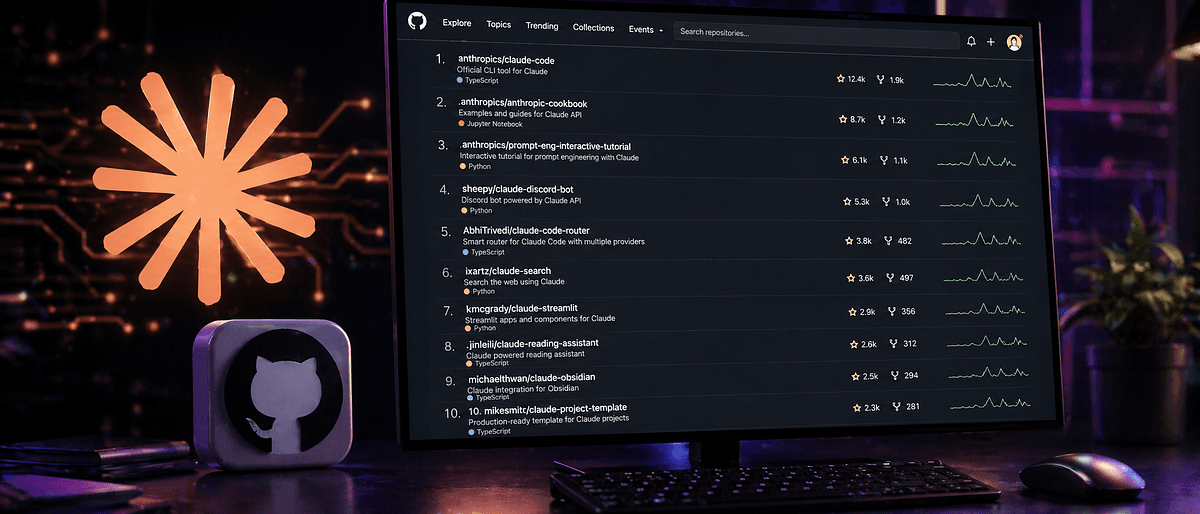
- Unlock Claude Code potential by integrating advanced GitHub repositories into your workflow.
- Most users miss the "ecosystem" features—hooks, subagents, and workflows—that transform Claude from autocomplete into an engineer team.
- These GitHub repos provide the infrastructure for production-grade AI operations, multi-step agent workflows, and expertise retrieval.
- Do not rely on the default interface alone; leverage these libraries to enforce rigor and scale workflows.
🎯 Introduction
If you are hunting for the best Claude Code GitHub repos to elevate your development workflow, the default interface won't satisfy you for long. While Claude Code has seen explosive adoption—amassing over 80,000 stars and spanning millions of commits—it is often underutilized. Most developers use it as a glorified autocomplete rather than a cognitive extension of their team. To truly master Claude Code, you must look beyond the chat window and into the GitHub ecosystem. The real power lies in repositories that provide critical hooks, modular frameworks, and subagent patterns that solve complex architectural problems.
🧠 Core Explanation
The current landscape of Claude Code GitHub repos isn't just about code generation; it is about orchestration. The user intent here is practical: "I have an account, but how do I run an enterprise-grade pipeline?" The content type is a Guide.
The core philosophy driving the best repositories is "agentic separation." Instead of feeding your entire monolith into a single context window—which is slow and prone to hallucination—top-tier repos implement a "router" architecture. They split tasks:
- The Planner: A subagent (often another LLM, like GPT-4o or another instance of Claude) breaks down the user's complex request into atomic tasks.
- The Executor: Claude Code (or a similar tool) executes the code changes, runs tests, and writes documentation.
- The Reviewer: A subagent runs diff comparisons against the original code to ensure expectations are met.
This separation of concerns is what turns a "chatbot" into a "coding autopilot."
🔥 Contrarian Insight
"Don't hand Claude your whole open-source repository. It will hallucinate."
I see countless engineers copy-pasting their entire src/ folder into a prompt. Here is the hard truth: Claude (and LLMs in general) cannot scale to long-tail file resolution without a massive context window. The winning repos in the ecosystem don't just have "advanced prompt engineering"; they have memory architectures (vector databases) and intelligent file-scoping. If you aren't using a repo that enforces "verify before commit" checks written by a separate logic layer, your production changes will pay for your API tokens with bugs.
🔍 Deep Dive / Details
Archetype: The "Router" Framework
The most effective GitHub repos in this ecosystem share a common architecture: they act as a middleware layer between the raw LLM output and the developer's workspace.
1. Expert RAG (Retrieval-Augmented Generation) Repos
Most developers struggle with hallucinating library names or outdated API documentation. High-value repos in this category use RAG to index your specific project repositories.
- What they do: They embed your code into a vector DB (like Pinecone or Chroma) and allow Claude to "chat" with your codebase data intelligently without the API cost of iterating through every file in the repo.
2. Subagent Orchestration (LangGraph / AutoGen clones)
Claude Code needs siblings. You want repos that implement frameworks like LangGraph. These repos allow you to define a graph of tasks (e.g., TDD_LOOP -> IMPLEMENTATION -> TESTS -> SUDO_COMMIT) where nodes are AI agents.
- Impact: This moves you from Interactive (human asks, AI answers) to Autonomous (Human defines path, AI executes).
3. Production Hooks & Middleware
Good repos handle the "noise." This includes Git hooks that run tests before git push or integrations that auto-generate PR descriptions and changelogs from your commit messages.
🏗️ System Design / Architecture
How does a "Master" repo actually handle the complexity?
If you look at the architecture of the leading Claude Kubernetes/Infra repos, you will find a distributed loop structure:
- Input Normalization: User asks in natural language.
- Task Splitting (The Router): The router analyzes the request. If it's "Build a backend," it spawns a
Backend_Agent. - Context Injection: The agent loads only the relevant function signatures and schemas from your repository (filtered via regex).
- Execution Layer: The agent writes code, saves files, and runs
npm run testorpytest. - Verification Loop: If tests pass, the repo triggers the
Sudo_Writepermissions. If they fail, it loops back to the agent with an error message. - State Persistence: A lightweight state store (Redis or file-based JSON) tracks which files were touched so agents don't step on each other's toes (locking).
🧑💻 Practical Value
Here is how to actually use this information to save time today:
- Don't read codes, run commands. Clone the top 3 trending repos.
- Start with the "Hello World". These repos usually have a demo setup (often in a
examplesfolder orREADME). - Hook it into your current project.
- Take one repo that focuses on Testing.
- Configure it to be the "Test Agent" in your Claude Code session.
- Command: Ask Claude: "Execute the full test suite for this module."
- Result: Claude writes the tests and confirms they pass, without you writing a single line of test code for the logic.
- Audit your API usage. The best repos include telemetry. If you are burning $500/month on "continuous chatting," you likely aren't using the architecture correctly.
⚔️ Comparison Section
| Feature | Default Claude Code | Top-Tier GitHub Repo Ecosystem |
|---|---|---|
| Scope | Single file / Immediate context | Multi-file, architect-level scope |
| Memory | None (Session based) | Vector Database / Persistent State |
| Error Handling | Basic reasoning | Loop-driven TDD enforcement |
| Safety | User Configurable | Git Hook enforced (Cherry-pick only) |
| Workflow | Ad-hoc交互 | Pre-defined Pipelines (Plan -> Execute -> Fix) |
⚡ Key Takeaways
- Absorb the Ecosystem: The 80k+ stars shared by these repos prove that modular architecture beats monolithic prompting.
- Separate Knowledge from Action: Use repos that pass only related code to Claude, rather than dumping entire libraries.
- Enforce Discipline: Implement TDD loops using subagent repos to kill bugs before they reach production.
- Optimize Context: Heavy context windows are expensive; use retrieval-based repos to bypass tracking every file in your repo history.
🔗 Related Topics
- How to Build a Multi-Agent System with Claude and LangGraph
- Refactoring Legacy Codebases with AI: A Developer's Guide
- Optimizing API Costs for AI Development Teams
- 5 Best VS Code Extensions for Claude 3.5 Sonnet
- System Design for AI Agents
🔮 Future Scope
The future of Claude Code GitHub repos lies in "Self-Healing" environments. We will soon see repos that not only generate code but spin up ephemeral Docker containers to run and test that specific code block in isolation before applying it to the main repository. The "Git Commit" will become a legacy command of the past, replaced by "Deploy to Staging" controlled by AI agents.
❓ FAQ
Q: Are these GitHub repos safe to merge directly into production?
- A: Generally, no. The most valuable repos in Claude Code (like subagent frameworks) are meant to be libraries you consult or orchestrate around. You should review the generated PRs, but the heavy lifting (talking to git, fixing linting errors) should be offloaded to the AI system.
Q: Do I need to pay extra for these repos?
- A: Most of the top Claude Code GitHub repos are open-source (MIT/Apache 2.0). The cost lies in the API credits you spend feeding your repo data to Claude multiple times during iteration.
Q: What is the best repo for absolute beginners?
- A: Look for "Template" repos that include a
syn_prompt.mdorconfig.json. These provide a hard-coded set of system instructions that act as an "onboarding" experience for the AI.
Q: Can I use these repos with other LLMs (like GPT-4)?
- A: Yes, most modern repos are model-agnostic. They simply output JSON payloads. However, Claude 3.5 Sonnet is currently the specific "wow" factor for code generation quality, so optimizations in repos often assume a strong coding model.
🎯 Conclusion
To move from using Claude Code as a toy to using it as an engineer requires abandoning the default toolset. The 15 GitHub repositories discussed here represent the foundational layer of the AI-native future. Master them, and you demote yourself from "code monkey" to "AI Architect."
If you found these resources helpful, bookmark this page and subscribe to the BitAI newsletter for monthly deep dives into the best open-source AI tools.
Share This Bit