IntelligenceAIAI AssistantLLMAI Agents
Agentic AI: 5 Design Patterns That Turn LLMs Into Autonomous AI Agents
🚀 Quick Answer
- Agentic AI design patterns transform LLMs into goal-driven AI agents
- The 5 core patterns are: reflection, tool use, planning, multi-agent systems, and human-in-the-loop
- These patterns enable reasoning, action, and adaptability
- Agentic AI goes beyond prompts → it executes tasks autonomously
- Essential for building production-grade AI systems
🎯 Introduction
Agentic AI design patterns are the foundation of modern AI systems that go beyond simple prompt-response behavior. While LLMs are powerful, they are still reactive — they respond, but they don’t act.
This is where Agentic AI design patterns come in.
Agentic AI design patterns enable LLMs to reason, plan, take actions, and adapt dynamically. Instead of generating one-shot answers, these systems operate in loops — thinking, acting, and improving continuously.
Developers often struggle with this gap. Here’s the catch: an LLM alone is not an agent. You need the right architecture.
🧠 Core Explanation
What is Agentic AI?
Agentic AI is a system design that transforms passive LLMs into goal-oriented agents capable of autonomous decision-making and action. :contentReference[oaicite:0]{index=0}
Instead of just generating content, these systems:
- Set goals
- Plan actions
- Execute tasks
- Adapt based on results
👉 In simple terms:
LLM → Thinker
Agentic AI → Thinker + Doer
🔥 Contrarian Insight
“LLMs don’t become powerful because they generate better text — they become powerful when they are allowed to act.”
Most developers optimize prompts.
But real breakthroughs come from system design, not prompt engineering.
🔍 The 5 Core Agentic AI Design Patterns
1. Reflection (Self-Improvement Loop)
Reflection allows an AI agent to review and improve its own output.
Flow:
Generate → Critique → Improve → Repeat
- Acts like a self-review system
- Improves accuracy and reasoning
- Reduces hallucination
👉 Reflection introduces a feedback loop where the model evaluates and refines its response before final output. :contentReference[oaicite:1]{index=1}
💡 In real-world usage:
- Code generation → run → fix errors → regenerate
2. Tool Use (Extending Capabilities)
LLMs are limited to training data.
Tools give them real-world power.
Examples:
- Web search
- Code execution
- APIs
- Databases
👉 Tool use allows agents to access external systems and perform actions beyond their internal knowledge. :contentReference[oaicite:2]{index=2}
💡 In my experience:
Giving an agent code execution is more powerful than adding 10 separate tools.
3. Planning (Breaking Down Problems)
Instead of solving everything at once, agents:
- Create a plan
- Execute step-by-step
- Adapt if needed
👉 Planning breaks complex problems into smaller tasks and executes them iteratively. :contentReference[oaicite:3]{index=3}
Example:
1. Research topic
2. Create outline
3. Write article
💡 Planning turns AI from reactive → strategic.
4. Multi-Agent Systems (Team of AI Agents)
Instead of one agent, you use multiple specialized agents.
Example:
- Research agent
- Coding agent
- QA agent
👉 Multi-agent systems allow collaboration between specialized agents to solve complex problems efficiently. :contentReference[oaicite:4]{index=4}
💡 Think of it like a company:
- Manager agent assigns tasks
- Worker agents execute
5. Human-in-the-Loop (HITL)
Not everything should be automated.
HITL adds human control at critical steps.
👉 This pattern introduces checkpoints where humans can approve, edit, or guide agent actions. :contentReference[oaicite:5]{index=5}
Use cases:
- Financial transactions
- Medical decisions
- Code deployment
💡 This is what makes AI systems safe and production-ready.
🏗️ System Design / Architecture
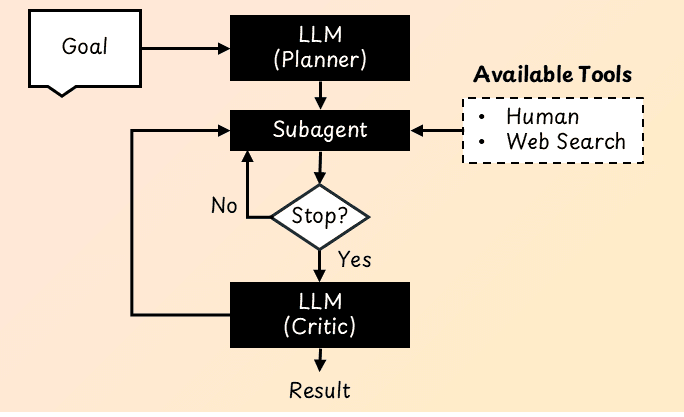
Agentic AI Loop
Perceive → Reason → Act → Observe → Repeat
👉 This continuous loop enables adaptive and autonomous behavior. :contentReference[oaicite:6]{index=6}
Full Architecture
User Query
   ↓
Planner
   ↓
Agent (LLM Brain)
   ↓
Tools / APIs / DB
   ↓
Reflection
   ↓
Final Output
Key Components
- LLM (reasoning engine)
- Memory (context retention)
- Tools (external actions)
- Orchestrator (workflow control)
👉 Agentic systems rely on planning, reasoning, and tool use to execute complex workflows. :contentReference[oaicite:7]{index=7}
🧑💻 Practical Value
What You Can Build
- AI copilots
- Autonomous customer support
- Coding agents
- Research assistants
- AI workflow automation systems
How to Implement (Simplified)
- Start with basic LLM
- Add tool calling
- Introduce planning
- Add reflection loop
- Scale to multi-agent
- Add human checkpoints
Common Mistakes
- ❌ Overengineering early
- ❌ No validation loop
- ❌ Too many tools
- ❌ No human control
⚡ Key Takeaways
- Agentic AI transforms LLMs into goal-driven systems
- Reflection improves output quality
- Tools enable real-world actions
- Planning enables complex problem solving
- Multi-agent systems scale intelligence
- Human-in-the-loop ensures safety
- System design > prompt engineering
🔗 Related Topics
- Build Agentic RAG using LangGraph
- LangChain vs LangGraph
- How to Reduce Hallucination in AI
- Multi-Agent Systems Explained
- AI System Design for Developers
🔮 Future Scope
Agentic AI is evolving fast.
Next wave:
- Autonomous companies (AI-run workflows)
- Self-improving agents
- Memory-driven AI systems
- Fully autonomous software development
👉 The shift is clear:
From AI tools → AI systems → AI agents → AI ecosystems
❓ FAQ
What is Agentic AI?
Agentic AI is a system that enables LLMs to act autonomously toward goals.
Why are design patterns important?
They define how AI systems reason, act, and scale.
Which pattern is most important?
Planning + tool use combined gives the biggest impact.
Do I need multi-agent systems?
Only for complex workflows — start simple.
Is Agentic AI production-ready?
Yes, but requires validation and human oversight.
🎯 Conclusion
LLMs changed how we generate content.
Agentic AI changes how we build systems.
These 5 design patterns are not optional anymore — they are the foundation of modern AI engineering.
In my experience, once you move from prompt-based systems to agent-based architectures, everything changes.
👉 You stop building chatbots
👉 You start building intelligent systems
And that’s where the real power begins.
Share This Bit