ChatgptClaudeAIAI AssistantAI Agents
AI Won’t Take Your Job. Your Stubbornness Will.
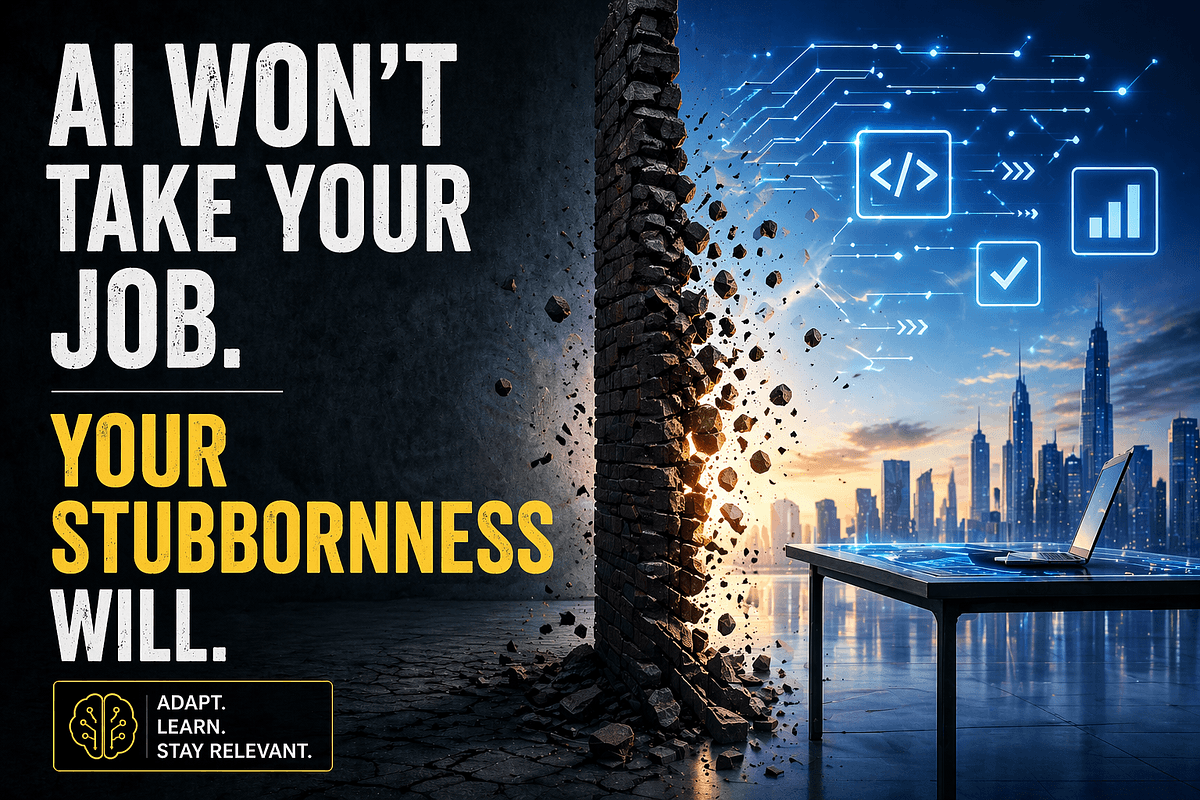
🚀 Quick Answer
- The real threat isn't model advancement: It’s the human refusal to integrate AI into the daily engineering workflow.
- Stubbornness blocks productivity: Engineers who reject tools like Copilot or Claude often suffer from inflated expectations on delivery speed.
- Adaptability is the survival skill: Success comes to those who leverage AI to handle boilerplate, not those who pride themselves on manual execution.
🎯 Introduction
Fear of artificial intelligence is largely a mirage, captured in headlines regarding automation. But looking closer at engineering groups, a different panic emerges. This is the silent embarrassment of the senior engineer who still refuses to use automated tools. AI Won't Take Your Job. Your Stubbornness Will. It is a harsh reality that top-tier talent is retiring not because they are beaten by code, but because they refuse to play the game. While the alarmists worry about robots replacing workers, the industry quietly loses ground to those who simply outpace everyone else by ignoring ego and embracing resistance to AI tools as a productivity trap.
🧠 Core Explanation
In the current ecosystem, the implementation of Large Language Models (LLMs) has shifted from a novelty to a baseline requirement. The "stubbornness" mentioned isn't just about being old-fashioned; it’s about a fundamental misunderstanding of the developer’s role. We once curated code like craftsmen curating marble. Today, we construct systems like architects building with rapid prototype materials. If you spend your day rewriting regular expressions or debugging syntax errors by hand because you "don't trust the model," you are not being diligent; you are being inefficient. The "authentic place" some developers claim to feel—pride in manual effort—is actually a confirmation bias preventing them from seeing the macro picture: output matters more than the process.
🔥 Contrarian Insight
"You aren't a craftsman curating art; you are a builder constructing infrastructure. Using AI to move sand is faster than picking it up by hand."
Insisting on manual execution in a GitHub Copilot world isn't "high performance" coding; it’s just busy work suited for a bygone era. The real arrogance is thinking your intuition is smarter than the aggregate intelligence of millions of lines of training data. If you are too proud to lean on a tool that compiles complex logic for you because you enjoy the struggle, you aren't building for the future—you're just rehearsing for a retirement that won't offer you work.
🔍 Deep Dive / Details
The "Stubborn Engineer" Mindset
Why does this happen? It usually stems from a counterintuitive pride. When a junior dev uses AI to solve a problem, they learn. When a stubborn senior refuses, they perform. This creates a professional blind spot. Ultimately, AI Won't Take Your Job. Your Stubbornness Will because the market rewards efficiency, not the romanticism of hard work.
The Productivity Gap
Studies show that AI adoption can reduce line-to-line productivity cycles dramatically by handling the boilerplate. Developers who cling to the "hard way" are artificially inflating their delivery times, making them appear less effective compared to their AI-enabled peers.
Real-World Usage
I have seen teams split. One half codes manually, prideful in their keystrokes. The other half, utilizing automation, apologizes early for scope but delivers 3x the value. The "slow and steady" team eventually hits a wall where the codebase is too massive to manage manually, while the AI team pivots to architecture and strategy. One group is preparing for layoffs; the other, for promotion.
🏗️ The Architecture of Adaptation
While this isn't a coding tutorial, looking at this through a systems lens reveals the problem. We are trying to patch a legacy workflow into a high-throughput environment.
- Legacy Workflow (Manually): Input $\to$ Brain Power $\to$ Syntax $\to$ Testing. A "chatty" bottleneck (you).
- Modern Workflow (AI-Aided): Input $\to$ Brain Power $\to$ Review/Synthesis. A streamlined pipeline.
The stubbornness is the software equivalent of trying to mix cement by hand instead of using a mixer just because you like the feeling of the shovel.
🧑💻 Practical Value
How to Overcome Stubbornness
Don't throw the baby out with the bathwater, but stop holding the bath water.
- Audit Your Pipelines: Look at your last ticket. How much time did you spend on syntax versus logic?
- The 80/20 Rule: Use AI to generate the first 80% of the code—structures, syntax, sort functions, unit test stubs. Spend 20% of your time on the logic and review.
- Restore Confidence: If you don't trust an AI's result, you are allowed to verify it. But if you verify it every time and still claim it's unreliable, you are the variable in the equation causing your own failure.
Pro Tip
The best developers are the ones who threaten the AI by using it too well. If you write a prompt that creates a fully functional module instantly, you owe the AI a thank you, not a collective sigh.
⚔️ Comparison Section
Manual Coding vs. AI-Assisted
| Feature | The Stubborn Engineer | The AI-First Engineer |
|---|---|---|
| Speed | Slow, iterative cycles | Fast, rapid prototyping |
| Mental Load | High syntax maintenance focus | High architectural logic focus |
| Risk of Error | Human typos | LLM hallucinations (managed) |
| Career Trajectory | Becoming a bottleneck | Becoming a leader/architect |
⚡ Key Takeaways
- Fear is misplaced: Focus on your workflow, not the model.
- Agility wins: Speed of delivery is the new currency of engineering.
- Efficiency > "The Process": Enjoying the struggle is a bad business strategy.
- Continuous Learning: Using tools today is the only way to manage them tomorrow.
- Stop the pride: Your tenure doesn't grant you immunity from adapting.
🔗 Related Topics
- The State of AI Coding Assistants: Beyond Copilot - A deep dive into the tooling landscape.
- Why Older Engineers Are Failing at AI Adaptation - Exploring generational divides in tech.
- How to Prompt Like a Senior Developer - Techniques to unlock AI potential.
- The Myth of "Jobs for Life" in Silicon Valley - Analyzing the threat of automation.
🔮 Future Scope
The gap between early adopters and the stubborn will widen drastically in the next 12 months. As context windows increase and IDEs integrate deeply with local inference models, the ability to do complex work in seconds will become the standard. Whatever career path you choose, ensure you are building a barge, not a kayak, if the ocean is turning into a torrent.
❓ FAQ
Q: Is it okay to not use AI tools? A: Yes, but only if your output is as fast or faster than AI-assisted coding. If it’s slower, you aren't choosing a method; you are choosing obsolescence. Q: Doesn't using AI hurt my skillset? A: No, it augments it. Learning when to apply AI is a higher-order skill than memorizing syntax. Q: I saw an AI make a mistake. Does this prove it's dangerous? A: No. Developers make mistakes too. The question is: Do you fix your mistakes, or do you hide from them because you pride yourself on not using the tool that could prevent them? Q: What defines "stubbornness" in this context? A: It is the refusal to augment human labor with machine capability simply because you value the overhead of execution over the value of the result. Q: Can I use AI safely in a regulated environment? A: Absolutely, by implementing strict verification protocols. Fear is not a security protocol.
🎯 Conclusion
The narrative that AI will replace us is a distractor. It is a convenient excuse for non-performance. The reality is starker: AI Won't Take Your Job. Your Stubbornness Will. If you remain too proud to let a machine help you build a skyscraper, you will lose the job to someone who will.
Stop comparing your behind-the-scenes struggle to someone else's polished result and start building.
Written for BitAI by a Senior AI Engineer.
Share This Bit