GoogleAndroid
Android Auto is now one (screen) size fits all: The I/O 2026 Update Explained
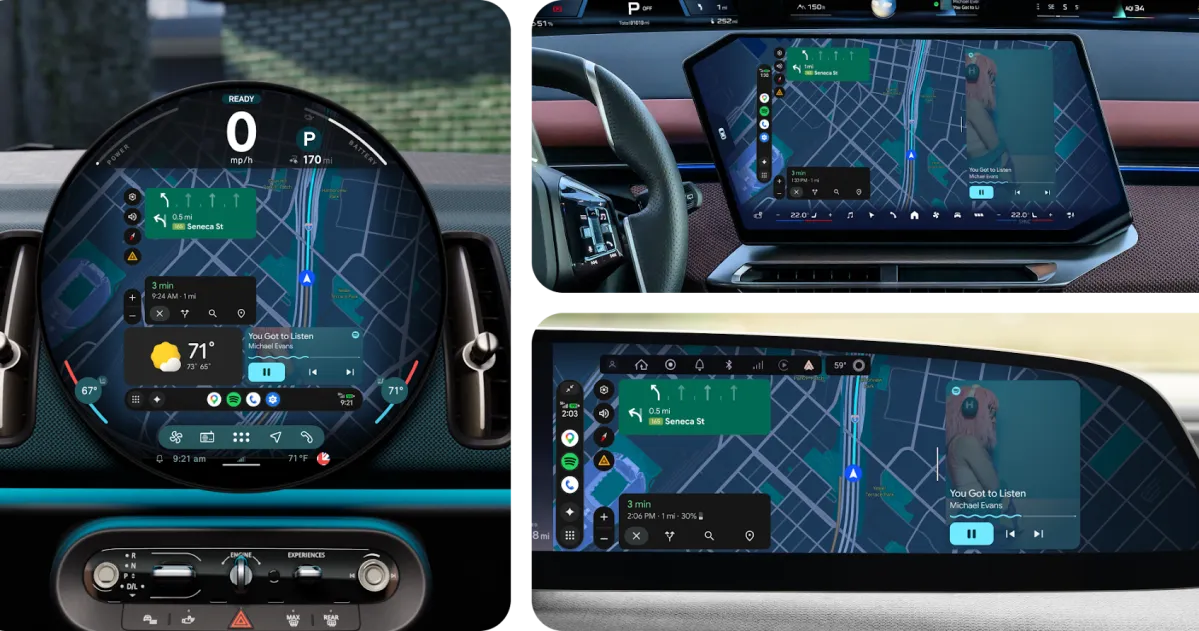
- Full Bleed Support: Google updated the engine so that Android Auto is now one screen size fits all, adapting layouts for curved, panoramic, circular, and trapezoidal displays like BMW’s "Neue Klasse."
- Media Breakthrough: Android Auto is now one screen size fits all for consumption, finally allowing users to stream YouTube (4K, 60fps, parked only) and play spatial audio during charging stops.
- Agent-Centric UI: The platform is shifting from app-centric buttons to AI assistant integration, allowing Gemini to act as a natural language proxy for apps like Starbucks and DashPass.
- Widget Expansion: Drivers can project custom widgets (sports, smart home) for one-tap interactions, reducing the need to pick up a phone.
- Native vs. Projection Blurring: Advanced EV features like battery preconditioning are now moving via software updates to projection users, meaning the world of embedded software is merging with phone projection.
🎯 Introduction
The automotive cockpit is turning into a battlefield for screen real estate, and Google has served its definitive strategy for Android Auto is now one screen size fits all. For a decade, the white box on the dashboard has remained stubbornly uniform, but the era of the ergonomic rectangle is dead. As VP of Android Automotive Patrick Brady noted, the Android Auto is now one screen size fits all paradigm is a necessity, driven by vehicles like the Lucid Air and the BMW Neue Klasse featuring "irregular trapezoid" or circular displays.
If you are a developer or power user, this is the biggest pivot in the system's 10-year history. We aren't just talking about UI tweaks; we are talking about a fundamental shift toward "full bleed" immersive design and a massive AI integration layer. In this deep dive, we analyze the architecture behind Google's aggressive update at I/O 2026, why it matters for the AV industry, and what this means for driver safety.
🧠 Core Explanation
Google’s announcement implies that the infrastructure previously built for fixed aspect ratios is being scrapped for a more fluid, geometry-aware rendering engine. The core update is the ability to render Android UI components so they "bleed" to the edges of the screen, regardless of the curvature or shape.
Previously, the system acted like an opaque container. Under the hood, this requires a responsive design system where layout boundaries are calculated dynamically based on the screen's bounding box rather than fixed pixels. It allows developers to create truly immersive components in Google Maps and media players that use every pixel of a panoramic display, ensuring that navigation lines aren't lost in dead space.
🔥 Contrarian Insight
"The biggest lie in automotive tech is that apps are good enough for the car."
We are finally moving past the era of "run-apps-on-a-car-screen." If there's one thing developers and engineers need to learn from this update, it's that apps are the enemy of safety. The "Full Bleed" and "Widget" updates are bandaids on a larger wound. Google isn't just making the machine look prettier; they are building Gemini as the new universal interface. They are shifting the paradigm from "Tapping apps" to "Verbal Intelligence." The AI agent shouldn't just answer; it should execute. We used to think projection would die because cars had their own OSs (Android Automotive/embedded). What we missed is that Android Auto became the OS because it offered access to the most powerful processors available: the user's smartphone.
🔍 Deep Dive / Details
The "Full Bleed" Implementation
This update addresses the visual inconsistency across modern EVs. Where older systems applied a 16:9 container to a non-rectangular screen, wasting ~30% of the viewable area on curves, the new system calculates layout vectors based on the screen's actual viewport.
YouTube & Content Streaming
The streaming implementation is a significant backend achievement. Since the video processing happens on the phone (rather than the car’s embedded hotspot), the system leverages the phone’s high-end GPU and high-bandwidth mobile data connection.
- Technical Detail: The car sends a "parked" state signal via a Bluetooth/USB handshake, which unlocks the DRM on the phone's media player.
- Stereo Support: By offloading the audio processing to the phone’s Dolby Atmos speakers or connected headphones, the car's interior acoustics don't dictate the audio quality.
The Material Three Expressive Design Language
Google is introducing Material 3 "Expressive" components to Android Auto.
- Semantic Color Palettes: The design system will now pull the current wallpaper color from the user’s Android phone to establish the interface theme. This reduces the cognitive load of adapting to a completely new UI every time you enter a rental car.
The "Magic Cue" & Safety
"Magic Cue" analyzes incoming text message patterns.
- Function: If a driver receives a text like "Pick me up at 5 PM", Magic Cue doesn't just play the audio; it parses the intent, pulls the Google Calendar data, and surfaces a "Navigate now" button, all without the driver touching the screen.
🏗️ System Design / Architecture
From a systems perspective, this update demonstrates a shift from Embedded-Oblivious to Embedded-Conscious.
1. The Projection Bridge (Phone-to-Vehicle)
- Input: The vehicle sends a
VEHICLE_STATE_PARK_POSITIONsignal. - Processing: The Android Auto daemon on the phone validates the state using the vehicle's API (ACPI signals).
- Output:
- Video: For YouTube, the phone streams media via the ChromeCast/AirPlay-like protocol (optimized for automotive latency).
- Data: For Widget updates, the phone pushes JSON payloads to the Android Auto service running on the vehicle's head unit.
2. Dynamic Geometry Rendering
Instead of CSS fixed units (px, rem), the UI renderer now uses dynamic viewport units (dvh concepts adapted for automotive). The layout engine detects non-linear screen boundaries (like the concave curve of a Lucid Air) and adjusts element z-indexes to ensure text remains legible relative to the driver.
3. The Gemini Agent Loop
- Intent Recognition: NLP analyzes the user's voice command.
- API Routing: Instead of opening an app UI, the agent generates an action verb:
callStarbucks.placeOrder. - Background Execution: The Android OS requests a permission context, executes the action in the background, and returns a success token to the UI.
🧑💻 Practical Value
For Users (Drivers): This update makes Android Auto less jarring when switching between older cars (rectangular screens) and new EVs (curved screens). The ability to stream YouTube isn't a toy; for people charging EVs or waiting in pickup lanes, it turns a 30-minute idle into a playback session.
For Developers: If you are building apps for Android Auto, you must restructure your UI for "Adaptability."
- Actionable Step: Review your current layout XML or Jetpack Compose code. Remove fixed aspect ratio constraints. Use
ConstraintLayoutorBoxwith percentage base anchors instead of pixel counts. - UX Rule: Do not assume a strictly 1024x600 screen. Plan for variable aspect ratios (e.g., 16:9, 21:9, and Conic/Curved).
⚔️ Comparison Section
| Feature | Google Android Auto (Latest Update) | Apple CarPlay | Legacy Android Auto |
|---|---|---|---|
| Screen Adaptability | "Full Bleed"; fills irregular trapezoids and curves. | Fixed aperture, stays rectangular in the center. | Fixed grid, black borders on odd shapes. |
| Streaming | YouTube (4K/60fps) available (Parking only). | no YouTube support. | No streaming support. |
| Interface Language | Material Three Expressive; haptic animations. | Carbon-based UI; minimal animations. | Standard Material Design from 2017+ variations. |
| AI Integration | Gemini Agent; executes app actions (Uber, Starbucks). | Siri limited to routine tasks; no app deep-linking. | Voice text only. |
⚡ Key Takeaways
- Geometry is dead: Android Auto is now one screen size fits all, utilizing a responsive backend to handle BMW's trapezoids and MINI's circles.
- YouTube Arrives: 4K/60fps YouTube streaming is locked behind the "parked" signal, solving the EV charging wait-time problem.
- Widgets are live: Users can stream real-time app data (sports, home security) in the car.
- The Bot replaces the App: Expect to stop "launching apps" and start "talking to Android" for complex tasks.
- OS Blurring: The distinction between "Projection" and "Native Android Automotive" is negligible as high-end features (EV battery control) are pushed back to projection devices.
🔗 Related Topics
- The Death of the Dedicated In-Car CPU: Why Automotive is Going Remote (Internal Link): How cars are relying on cloud and phone processing more than ever.
- Material 3 Expressive Design: A Technical Breakdown (Internal Link): How Google is changing mobile UI patterns.
- AI in the Driver's Seat: Will LLMs Replace Navigation Apps? (Internal Link): The future of chat-based routing vs Maps integration.
🔮 Future Scope
We can expect this "Full Bleed" architecture to be the foundation for Android 15/16 automotive updates. Furthermore, the "Magic Cue" feature will likely evolve to support regional languages, lowering the barrier to entry for global markets. The next step after Widgets is Live Transcription—where Android Auto listens to conversations around the car and surfaces relevant information (like "Did you forget your umbrella? It's raining") without specific keywords.
❓ FAQ
Q: Can I watch YouTube while actually driving? A: No. The feature is strictly locked to the "Parking State." The car sends a signal to the phone to verify the vehicle is stationary before unlocking the video DRM.
Q: Do the imperceptible curved screens affect usability? A: Google claims the new algorithm maintains legibility by tracking the curvature and calibrating font sizes at the "sweet spot" for the driver's eye.
Q: Will this work on older cars? A: Yes. This is a software update for the head unit's version of Android Auto, not a hardware requirement on the car, provided the screen supports the new display protocols.
Q: What is "Full Bleed" UI? A: It is a design principle where content fills the entire canvas up to the edge of the viewport, unlike traditional design where content sits inside a "card" or box with margins.
Q: What apps will support the "Magic Cue" feature first? A: Google initially mentioned integration with messaging apps and Google services; expect enterprise integrations (Uber, DoorDash, Starbucks) to follow shortly after the update launches.
🎯 Conclusion
Google’s assertion that Android Auto is now one screen size fits all is more than a marketing slogan; it is a technical requirement for the modern automotive era. By decoupling the rendering engine from the physical screen shape and marrying it with a generative AI agent, Google is effectively building a "software layer" that sits on top of every metal and glass dashboard in the world.
For developers, this signals a push toward agentic interface design—building systems that listen and do, rather than just display buttons.
Share This Bit