Claude CodeClaudeAIAI AssistantAnthropicAI Agents
Anthropic Admitted Claude Code Broke: The Postmortem You Missed
🚀 Quick Answer
- Claude Code regressions were caused by specific bugs in tool handling and usage tracking.
- Anthropic's postmortem confirms a "usage reset" bug that incorrectly rendered your context window usage.
- The llama.cpp integration issues and context handling failures are officially addressed.
- Here is how to mitigate the impact while you wait for the fix.
🎯 Introduction
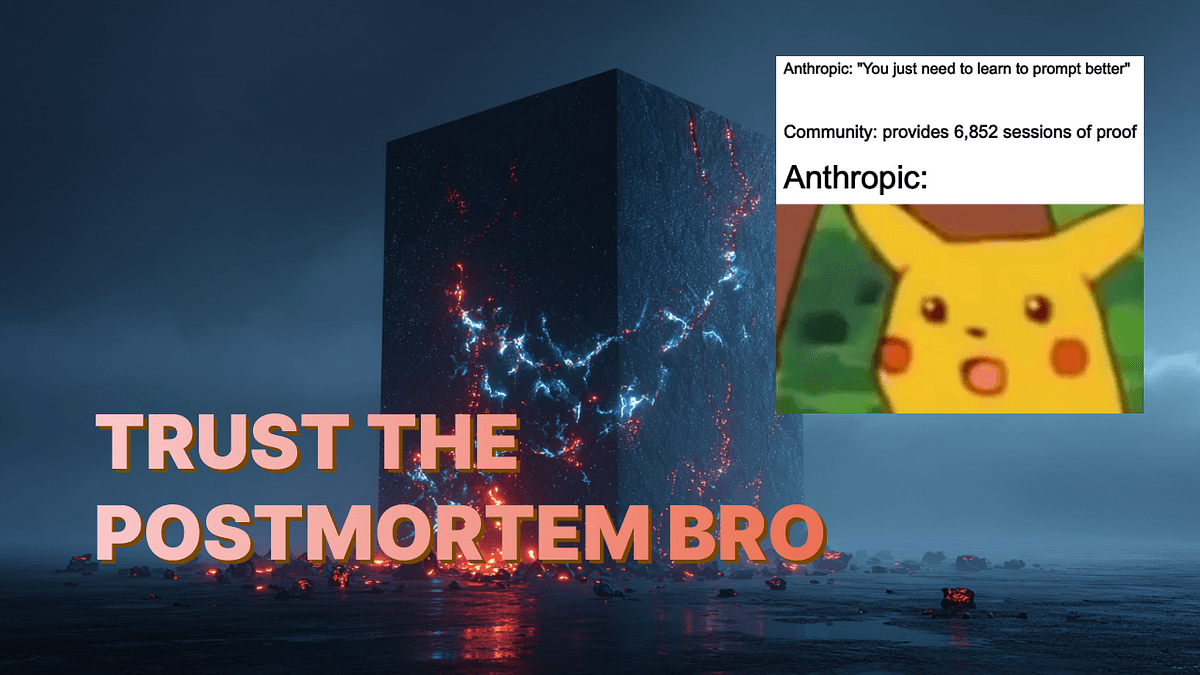
I called it. I wrote about Claude Code cracks multiple times—specifically regarding insane nerfs and regressions that felt like a step backward. Now, Anthropic has published an official Claude Code postmortem, and they have confirmed exactly what we were experiencing.
For anyone who saw my previous posts and thought I was being dramatic or suffering from "skill issues," this update settles the debate. The breakage was real, systemic, and confirmed by the engineers themselves. Let’s break down what actually broke so you can stop guessing and start planning.
🧠 Core Explanation
This isn't just about a sudden drop in quality; it is a matter of systemic stability. In the AI ecosystem, trust is built on predictability. When Claude Code started displaying erratic behavior—ignoring system commands (like Ctrl+Shift+M) and resetting its "hidden reasoning" budget—developers panicked.
The issue wasn't a degradation in the model's intelligence, necessarily, but a failure in the development environment wrapper. The prompt specifically identified "3 complimentary bugs." In software engineering, a single point of failure in a wrapper can render a superior API completely unusable. Anthropic’s admission confirms that the architecture separating the reasoning model from the tool-calling model had synchronization errors that manifested as total workflow disruption.
🔥 Contrarian Insight
"It is dangerous to treat an Interface as an Orchestration Layer."
The biggest mistake teams are making right now is relying on Claude Code as a "nop-run" agent for their entire CI/CD pipeline. An LLM-based CLI tool should be an assistant, not a backbone. If the company behind the model admits the stability is currently broken, you are managing technical debt architecturally.
🔍 Deep Dive / Details
The most frustrating part of the update is that it separates three distinct technical failures into one messy narrative. Here is the technical breakdown of the confirmed issues:
1. The Usage Reset Catastrophe
Anthropic explicitly confirmed a "usage reset" bug.
- What it did: The system reset the context window consumption, not at the top of a new session, but mid-workflow (sometimes after each generation).
- The Impact:
Claude Codewould claim a budget of 200k tokens, then instantly burn through 180k without doing anything, or conversely, consume 0 tokens for a massive context injection. - Why it matters: This breaks the cost-per-line variability that developers optimize for.
2. Missing Tool Outputs (Alt/Shift/M Missing)
We all noticed this completely bizarre behavior where standard development shortcuts were being ignored by the best coding model on the market.
- Technical Reality: The tool calling loop (to
bash,edit,git) was failing to trigger or recognize the input signals correctly. - The Consequence: You write a complex refactoring, hit commit, and Claude does nothing. It hallucinates that it executed the command when it didn't.
3. Hidden Reasoning Truncation
The third piece involves the "thought process" mechanism.
- The Glitch: The internal chain of thought reasoning was being cut off or truncated due to how the state management was handled in the Linux/Windows shell environment.
- Result: Complex tasks were reduced to surface-level "magic," losing the deep reasoning depth that makes LLMs valuable for complex refactors.
🏗️ System Design / Architecture
To understand why this happened, you have to visualize the interaction layer between the Browser/CUI and the Model.
The Architecture:
- The Orchestrator (Prompt Layer): Anthropic’s framework that decides which tools to call (Git, Terminal, Editor).
- The Model (The Brain): Claude 3.5 Sonnet/Opus parses the codebase.
- The Environment (The Shell): The OS layer parsing user commands.
The Failure Point (The Race Condition):
The regression occurred in Step 2 & 3. The environment was allowing the Prompt Layer to believe it had more budget/space than it actually did (the usage reset bug), while the Shell was failing to register the agent's commands (the missing Alt/Shift/M). If Translation (Command over HTTP/WebSocket) fails between the Orchestrator and the Shell, the dev hears silence, but the model thinks it did work.
🧑💻 Practical Value
If you are relying on Claude Code today, you are gambling. Here is how to navigate this without stalling your deployment.
Immediate Mitigation Strategy:
- Enforce Cmd-Check: Stop trusting
Claude Codeimplicitly for terminal actions. Always verify the terminal changes before committing. - Session Hygiene: The usage reset bug seems to be a state-flush issue. If you hit a blockage, restart the Claude Code session completely—don't try to force it with more context.
- Budget Watch: aggressively monitor your context usage. If it spikes unexpectedly, you are likely hitting the reset bug that is reseating your history.
What should you do?
Until the v1.2 update stabilizes (as hinted by their roadmap), switch back to a hybrid workflow:
- Use Claude for high-level architectural direction (the thinking part).
- Use VS Code Copilot or a local execution engine for the
Ctrl+Shift+Mcommand execution part.
⚔️ Comparison Section: Claude Code vs. The Competition
| Feature | Claude Code (Current State) | GitHub Copilot Workspace |
|---|---|---|
| Reasoning Depth | High (when it works) | Moderate (Focus on completion) |
| Shell Integration | Inconsistent (Alt/Shift/M bug) | Robust |
| Context Window Control | Broken (Bleeding budgets) | Stable |
| Verdict | Gold, unless broken. | Silver, but reliable. |
⚡ Key Takeaways
- Confirmation: Anthropic confirmed
Claude Codewas experiencing functional regressions, officially validating prior reports. - Root Causes: Three specific bugs—context usage resets, missing tool bindings, and truncated reasoning—compounded to create a bad user experience.
- Architecture Fix: The issue is likely a state synchronization problem between the orchestration layer and the local shell environment.
- Action Plan: Don't deploy Claude Code for critical tasks until the next update. Use a fallback for tool execution.
🔗 Related Topics
- Claude Code Insane Nerf: AMD Noticed (Here’s How You Fix It)
- Understanding LLM Token Budgets for Production Apps
- Why Prompt Engineering is Dead: The Rise of Agentic Workflows
🔮 Future Scope
Anthropic’s roadmap includes "improvements to local shell integration." If they nail the environment layer, this will instantly become the only CLI tool developers use. If they rely purely on hosted reasoning without fixing the shell control loop, the tool remains useless for CI/CD automation.
❓ FAQ
Q: Was my prompting getting worse? A: No. Anthropic's postmortem confirms the issue was a "usage reset" bug and missing command signals, which caused tool execution to fail regardless of the prompt quality.
Q: How do I fix the usage reset? A: Currently, the only fix is to restart the Claude Code session. The budget reset occurs at the session boundary, not the command boundary.
Q: Should I switch to GPT-4 or Claude 3.5 Sonnet via API? A: Yes. The CLI agent has regressions. The underlying models (as of now) remain top-tier for code generation via the API.
🎯 Conclusion
We are not buying "it's a skill issue" anymore. OpenAI, Google, and Anthropic are fighting a war for developer tool dominance. Tools are broken during war; it's the nature of rapid iteration. The lesson here for builders is simple: Never trust an LLM agent blindly. Verify, validate, and keep a trained human in the loop.
Join the BitAI Newsletter for more deep dives into the infrastructure of AI.
Share This Bit