AIAI AgentsAI AssistantLLMRAGlanggraph
Build Agentic RAG using LangGraph (Step-by-Step Guide with Code)
🚀 Quick Answer
- Agentic RAG uses AI agents to dynamically decide retrieval strategy
- Agentic RAG improves accuracy and reduces hallucination
- Built using LangGraph workflows (nodes + edges + conditions)
- Supports multi-source retrieval (vector DB + web search)
- Handles out-of-syllabus queries intelligently
🎯 Introduction
I remember a situation from my 7th-grade English exam. One question was out of syllabus, and all the students panicked. Later, the teacher gave marks anyway — everyone was happy.
But in real-world AI systems, this doesn’t happen.
When building a Agentic RAG system, users will ask questions outside your dataset. Traditional RAG fails here. That’s why Agentic RAG exists — to handle unknown queries intelligently.
Developers often struggle with this exact problem. Here’s the catch — users will always ask unexpected questions. You can’t control users, but you can design a smarter system.
🧠 Core Explanation
What is Agentic RAG?
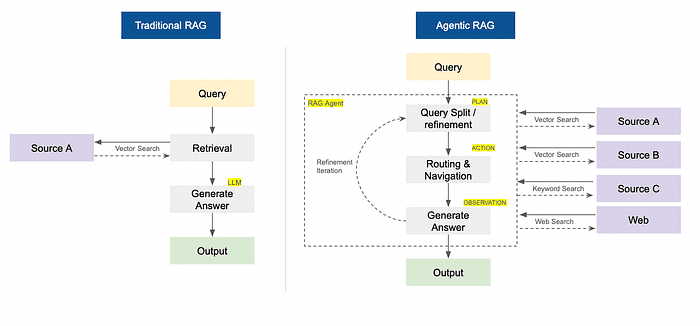
Agentic RAG is an advanced version of Retrieval-Augmented Generation where an AI agent decides how and where to retrieve information dynamically. :contentReference[oaicite:0]{index=0}
Instead of a fixed pipeline, it introduces decision-making and reasoning before retrieval.
👉 Traditional RAG:
Retrieve → Generate
👉 Agentic RAG:
Think → Decide → Retrieve → Validate → Generate
Agentic systems allow models to retrieve from multiple sources and adapt dynamically, improving accuracy and flexibility. :contentReference[oaicite:1]{index=1}
⚔️ Traditional RAG vs Agentic RAG
| Feature | Traditional RAG | Agentic RAG |
|---|---|---|
| Retrieval | Single-step | Multi-step |
| Intelligence | Static | Dynamic |
| Adaptability | Low | High |
| Sources | Fixed | Multiple |
| Accuracy | Medium | High |
👉 In real-world usage, Agentic RAG behaves like a problem-solving assistant, not just a retriever.
🔥 Contrarian Insight
“Most RAG systems don’t fail because of bad embeddings — they fail because they don’t think before retrieving.”
Everyone optimizes vector search.
Almost no one optimizes decision-making before retrieval.
That’s why Agentic RAG wins.
🔍 Deep Dive / Details
Why Traditional RAG Fails
- ❌ Single-pass retrieval
- ❌ No validation of context
- ❌ Cannot handle unknown queries
- ❌ High hallucination risk
These limitations make traditional systems unreliable in production environments. :contentReference[oaicite:2]{index=2}
How Agentic RAG Works
Agentic RAG introduces an intelligent loop:
Query → Router → Retrieval → Relevance Check → Generate
                          ↓
                     Web Search (fallback)
Instead of one-shot retrieval, it becomes an iterative reasoning system. :contentReference[oaicite:3]{index=3}
🏗️ System Design / Architecture
High-Level Components
1. Router Agent
- Decides:
- Q&A Dataset
- Device Dataset
- Web Search
2. Retrieval Layer
- ChromaDB collections
- Semantic similarity search
3. Relevance Checker
- Validates retrieved context
4. Generator
- Produces final answer using LLM
Why LangGraph?
LangGraph allows you to define workflows as graphs:
- Nodes = actions (retrieve, validate, generate)
- Edges = flow logic
- Conditional edges = decisions
This enables dynamic and scalable AI pipelines. :contentReference[oaicite:4]{index=4}
🧑💻 Practical Implementation
Tech Stack
- Python
- LangGraph
- LangChain
- ChromaDB
- SerperAPI (Web Search)
- OpenAI API
Step 1: Install Dependencies
pip install langchain langgraph chromadb openai sentence-transformers
Step 2: Setup Vector Database
import chromadb
client = chromadb.PersistentClient(path="./chroma_db")

collection1 = client.get_or_create_collection(name="medical_q_n_a")
collection2 = client.get_or_create_collection(name="medical_device_manual")
Step 3: Simple RAG Flow
Query → Retrieve → Prompt → Generate
Limitation:
- Fails on unknown queries
Step 4: Build Agentic RAG
Key idea: 👉 Add a Router + Relevance Checker
Flow:
Query → Router → Retrieval → Check → Generate
Step 5: Router Logic
def router(state):
    decision_prompt = f"""
    Decide:
    - Retrieve_QnA
    - Retrieve_Device
    - Web_Search
    """
Step 6: Relevance Checker
def check_context_relevance(state):
    prompt = "Is context relevant? Yes or No"
Step 7: LangGraph Workflow
workflow = StateGraph(GraphState)

workflow.add_node("Router", router)
workflow.add_node("Retrieve_QnA", retrieve_context_q_n_a)
workflow.add_node("Retrieve_Device", retrieve_context_medical_device)
workflow.add_node("Web_Search", web_search)
workflow.add_node("Relevance_Checker", check_context_relevance)

workflow.add_edge(START, "Router")
🧑💻 Practical Value
What You Can Build
- AI customer support bots
- Medical assistant systems
- Developer copilots
- Knowledge-based AI search
Production Tips
- Use max 3 iterations for loops
- Add caching (Redis)
- Log routing decisions
- Use better models for routing
Mistakes to Avoid
- ❌ Single data source
- ❌ No validation
- ❌ Ignoring out-of-scope queries
- ❌ Overloading context
⚡ Key Takeaways
- Agentic RAG adds decision-making to RAG
- Handles unknown queries effectively
- Reduces hallucination via validation
- Enables multi-source retrieval
- LangGraph makes workflows flexible
- Essential for production AI systems
🔗 Related Topics
- How to Scale Vector Databases to 10 Million Users
- LangChain vs LangGraph
- Reduce Hallucination in RAG Systems
- Build AI Agents with OpenAI
- ChromaDB vs Pinecone
🔮 Future Scope
Agentic RAG is evolving fast:
- Multi-agent systems
- Self-improving AI
- Memory-based reasoning
- Autonomous workflows
Agentic AI systems are becoming more independent, adaptive, and capable of solving real-world problems. :contentReference[oaicite:5]{index=5}
❓ FAQ
What is Agentic RAG?
An advanced RAG system where AI agents control retrieval decisions.
Why is it better than traditional RAG?
It adapts dynamically and handles unknown queries.
What is LangGraph?
A framework to build agent workflows using graph-based execution.
Does it reduce hallucination?
Yes, through validation steps.
Is it production-ready?
Yes, widely used in modern AI systems.
🎯 Conclusion
Traditional RAG is static.
Agentic RAG is intelligent.
It transforms your AI from a passive responder into an active problem solver.
In my experience, adding routing + validation instantly improves accuracy.
👉 Start building today — because the future of AI isn’t just generating answers.
It’s deciding how to get them.
Share This Bit