ClaudeAIAI AssistantAnthropicAI Agents
Claude Connecters: Anthropic Finally Adds Personal Apps (Spotify, TurboTax) & Privacy Wins
🚀 Quick Answer
- What are they? Claude Connectors are a new middleware layer allowing Anthropic's AI to securely access and control external apps like Spotify and Uber directly from chat.
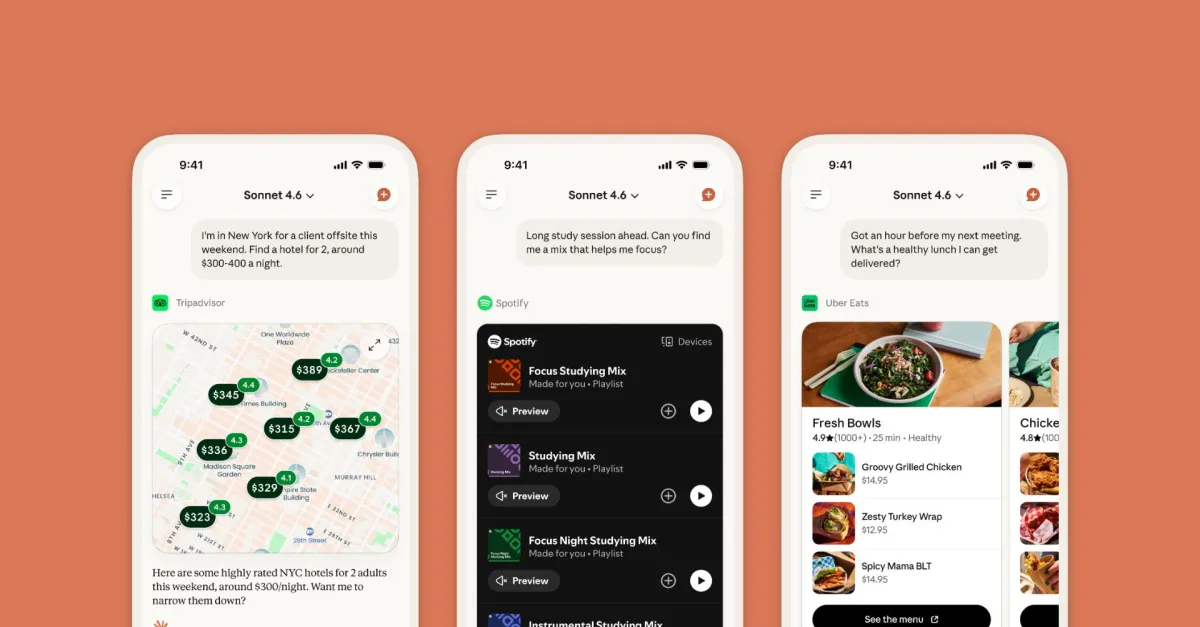
- Which apps are new? The rollout now includes personal favorites like Uber, Uber Eats, Spotify, AllTrails, TurboTax, Instacart, and Audible, moving beyond enterprise tools.
- Is it safe? Anthropic explicitly prohibits using your connected data for training and forbids paid placements—privacy is the core differentiator.
- Availability: Live for all Claude plans (including free) with mobile support currently in beta.
🎯 Introduction
Anthropic has quietly pivoted its strategy by expanding Claude connectors to support personal apps like Spotify, Uber Eats, and TurboTax. This is a massive shift from enterprise-only tools. If you have been waiting for an AI personal assistant that can actually handle your life tasks, here is what you need to know about the new Claude connectors rollout. This isn't just a gimmick; it's a fundamental change in how AI intersects with your daily Amazon, Uber, and banking apps.
🧠 Core Explanation
For a long time, AI tools were handcuffed to "work" spaces (Slack, Notion, GitHub, Microsoft 365). The problem? I can't ask an AI to reorder my Echo Dot or reserve a table at a specific time. The new Claude app connectors bridge that gap. By allowing direct access to personal life apps, Anthropic is trying to replace the fragmented ecosystem of fitness trackers, grocery delivery, and travel planning with a single semantic interface.
Anthropic is explicitly framing this as a "Mobile in Beta" feature. They aren't trying to replace your iPhone’s native apps, but rather merge them into the context of your conversation. If you ask Claude, "Plan a hiking trip this weekend using my location," the AI can seamlessly bring up AllTrails, Google Maps (via search), and then Uber to get you there, all in one flow.
🔥 Contrarian Insight
"While OpenAI is effectively charging an 'OpenAI Tax' by letting corporations pay for ad insertion in your personal chat, Anthropic is winning the 'Trust Game' by fundraising to build privacy—granting Claude Connecters zero ability to profit from your Spotify listening history or Uber ride data."
Most people focus on model performance (token count, hallucination rates). But as connectivity increases, privacy becomes the product. OpenAI’s current plugin model allows for sponsored answers. Anthropic’s stance here that "there are no paid placements or sponsored answers" is a massive competitive moat and a dealbreaker for privacy-conscious users.
🔍 Deep Dive / Details
The App Ecosystem
Anthropic is targeting the "富人" (wealthy) or "精通科技者" (tech-savvy) demographic by expanding to apps like TurboTax (financial), AllTrails (lifestyle), and TripAdvisor (travel). While most high-profile AI news focuses on coding assistants, this is where the real "sticky" user behavior lives. People are willing to share location or payment methods only if they trust the AI not to leak that data to third-party advertisers.
Privacy Architecture
The most interesting part of this announcement isn't the apps, but the sanctions. Anthropic states:
"Your data from [connected apps] isn't used to train our models, and the app doesn't see your other conversations with Claude."
This is a Zero-Data Retention model. In architectural terms, this means the data flows: App API -> Connector Middleware -> LLM Context Window -> User. It never touches Anthropic's long-term human-review pool for training. For regulators like the EU's GDPR, this architecture is much easier to model for compliance than OpenAI's broader user engagement analytics.
🏗️ System Context (Developer Perspective)
If you are a developer looking to replicate this functionality, you aren't building a simple API wrapper. You are building a Secure Intent Gateway.
1. The Data Flow:
- User: Sends natural language intent ("Book a table for 2").
- Claude: Interprets intent and requests
/api/v1/uber-booking. - Middleware: Verifies intent boundaries (Safety Guardrails). Did the user intend to spend $500?
- App Layer: Executes the request using the User's personal API tokens (OAuth 2.0 delegated privileges), not Anthropic's.
2. State Management: Unlike OpenAI's current approach, where the assistant maintains complex concurrent states, Anthropic's approach seems to be a "Session-Per-Action" flow. This prevents the AI from being tricked into chaining malicious actions (e.g., "Open the app, then sign a contract").
🧑💻 Practical Value: How to Set It Up
You don’t need a developer key to use this. Here is the workflow every user should adopt:
- Log into Claude Web or App.
- Go to: The Customize sidebar (usually on the left).
- Select: "Connectors" tab.
- Add: Spotify, Uber Eats, or Turbotax.
- Verify: Anthropic will prompt you to use your specific credentials for the app to authorize the flow.
- Test: Ask Claude, "What’s on my Uber Eats order?" followed by "Cancel it" (then confirm).
Developer Note: If you are building this, ensure you handle the reauth_tokens correctly. These connectors often expire or require renewed permission for sensitive actions (money/booking).
⚔️ Comparison: Claude vs OpenAI Connectors
| Feature | Claude Connectors (Anthropic) | ChatGPT Plugins (OpenAI) |
|---|---|---|
| Focus | Personal life + Work | Enterprise + Community extensions |
| Sponsored Answers | ABSOLUTELY FORBIDDEN | Yes, allowed |
| Model Context | Extremely strict privacy guardrails | More flexible, relies on ecosystem |
| Personal Data | Yes (Spotify, etc.) | Yes (Zapier, Slack, etc.) |
| Mobile Beta | Yes | Native mobile integration is better |
⚡ Key Takeaways
- Personalization: The biggest hurdle for AI adoption is moving from "chatting" to "doing." Claude Connectors bridge that gap via personal apps.
- Surveillance vs. Privacy: Anthropic has taken a strong stance against ad-supported AI answers, which is a genuine value add for privacy advocates.
- Mobile Beta: This is currently restricted to mobile, but web access will likely follow shortly to capture desktop workflow efficiencies.
- Action Required: Users must actively connect apps in the "Customize" sidebar. You cannot access them by default yet.
🔗 Related Topics
- How to configure Claude for Developers
- OpenAI GPTs: The Ultimate Privacy Comparison
- Anthropic Claude vs GPT-4: The ultimate showdown
- Building secure AI agents with Function Calling
🔮 Future Scope
We can expect this to expand to smart home ecosystems (Amazon Alexa, Google Home) and banking (Plaid). The ability to have an AI confirm a transaction contextually ("I want to pay John Doe again, is this a legitimate recurring payment?") before execution is where the market will split between OpenAI and Anthropic.
❓ FAQ
What is a Claude Connector? It is a secure integration that allows Claude to read and act upon data from third-party applications like Spotify or Uber using your specific credentials.
Is my data used to train Claude? No. Anthropic explicitly states that data from connectors is not used to train their models, nor does the connected app see other messages in your conversation.
Can I add any app? Currently, Anthropic has a curated list of supported apps (Spotify, Uber, TurboTax, etc.). It is not an open marketplace like OpenAI's.
🎯 Conclusion
The news that Claude connectors now support personal apps signals that Anthropic has won the "Productive Privacy" war. By ensuring your personal data isn't used to train their models or serve you ads, they've created a compelling use case for the average user. If you manage your digital life through Spotify and Uber, deleting OpenAI's plugins to test Claude's free approach is a no-brainer experiment.
BitAI says: The future of AI isn't just about how smart the model is—it's about how humble it is with your personal life data.
Share This Bit