AI EngineerAI
From QA to AI Engineer: The Real Roadmap Nobody Tells You (Complete 2026 Guide)
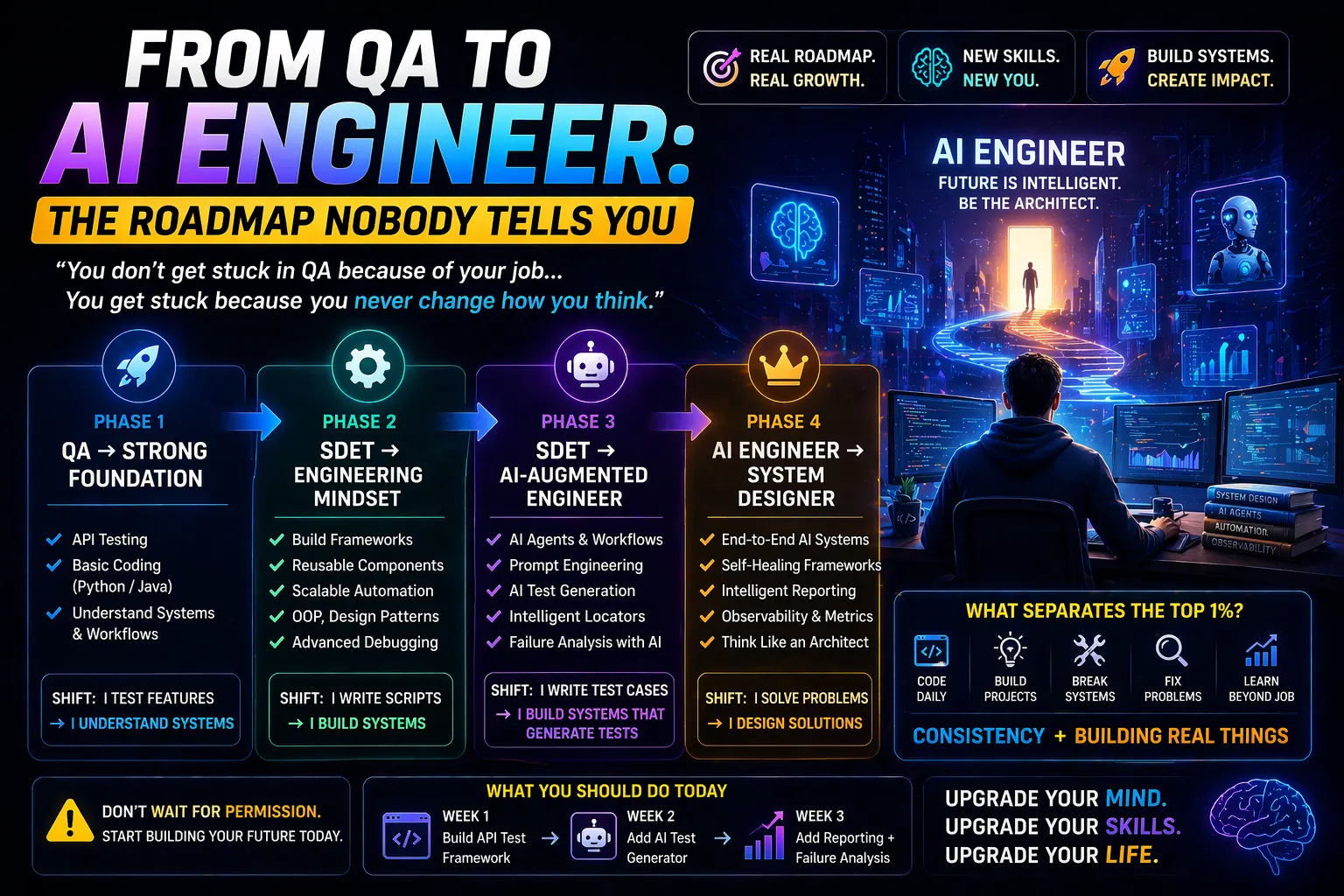
- QA to AI Engineer is no longer about learning Selenium alone — it is about building intelligent systems.
- The fastest roadmap is: QA → SDET → AI-Augmented Engineer → System Designer
- Developers who build real frameworks and AI workflows grow faster than engineers who only watch tutorials.
- Modern QA engineers must understand APIs, automation frameworks, AI agents, observability, and system design.
- The future belongs to engineers who can combine testing + AI + architecture thinking.
🎯 Introduction
The biggest mistake most QA engineers make is believing that becoming an AI Engineer requires years of advanced research or machine learning theory.
It does not.
The real QA to AI Engineer roadmap is much more practical.
You move from:
- testing features
- to understanding systems
- to building frameworks
- to designing AI-powered automation systems
The market has already changed.
Companies are no longer looking for engineers who can only execute test cases manually. They want engineers who can:
- automate workflows
- understand system architecture
- integrate AI into testing pipelines
- build scalable testing platforms
And honestly, this shift is accelerating faster than most people realize.
In real-world usage, developers often struggle not because they lack intelligence — but because they never move beyond tutorial-level learning.
Here’s the catch:
Watching AI videos does not make you an AI Engineer.
Building AI systems does.
🧠 The Reality Nobody Tells You
Most QA engineers fail for one simple reason:
They learn randomly.
Not strategically.
They jump between:
- Selenium tutorials
- ChatGPT prompts
- random GitHub repositories
- incomplete side projects
But never develop execution depth.
The top engineers are different.
They:
- build systems repeatedly
- debug real-world failures
- think in architecture
- optimize workflows
- understand scalability
That is what separates average engineers from high-value engineers.
🚀 The REAL QA to AI Engineer Roadmap
We break this into 4 execution-focused phases.
Not theory.
Real engineering progression.
🧱 PHASE 1: QA → Strong Engineering Foundation (0–2 Months)
🎯 Goal
Stop being a test executor.
Start becoming a system-aware engineer.
🔥 What You MUST Learn
1. API Testing
This is your first non-negotiable skill.
Learn:
- HTTP methods
- request/response lifecycle
- authentication
- headers
- status codes
- JSON validation
Tools:
- Postman
- Python requests
- REST Assured
- Playwright API testing
2. Basic Coding (Python Recommended)
Do not focus on syntax memorization.
Focus on:
- logic building
- debugging
- functions
- data structures
- real automation problems
Python is ideal because:
- simple syntax
- huge AI ecosystem
- automation-friendly
3. System Understanding
This is where most QA engineers stay weak.
Understand:
- frontend/backend communication
- authentication flow
- JWT tokens
- caching
- session handling
- database interactions
If you cannot explain how data moves inside a system, you cannot become a strong AI Engineer.
🛠️ Project 1: API Testing Framework
Build this yourself.
Do not copy YouTube code blindly.
import requests

def test_login():
    response = requests.post(
        "https://example.com/api/login",
        json={
            "username": "test",
            "password": "1234"
        }
    )

    assert response.status_code == 200
🔥 Upgrade Tasks
Add:
- environment handling
- token management
- logging
- reusable request helpers
- response schema validation
⚠️ Common Mistake
Watching tutorials for months without building anything.
Tutorial addiction destroys engineering growth.
💡 Outcome of Phase 1
You stop saying:
❌ "I test features"
You start saying:
✅ "I understand how systems behave."
⚙️ PHASE 2: QA → SDET (2–5 Months)
🎯 Goal
Think like a software engineer.
Not just a tester.
🔥 What You MUST Learn
OOP Concepts
Learn:
- classes
- inheritance
- abstraction
- encapsulation
Because frameworks require architecture thinking.
Design Patterns
Focus on:
- Page Object Model
- Factory Pattern
- Singleton
- Builder Pattern
These patterns make frameworks scalable.
Debugging Skills
This is massively underrated.
Top engineers spend more time debugging than coding.
Learn:
- browser debugging
- network inspection
- logs analysis
- stack traces
- async issue tracking
🛠️ Project 2: Full Automation Framework
Structure:
framework/
 ├── tests/
 ├── pages/
 ├── utils/
 ├── config/
 ├── reports/
 ├── logs/
Include
- Selenium or Playwright
- Pytest
- reporting
- config management
- environment support
- reusable utilities
🔥 Upgrade Tasks
Add:
- retry logic
- parallel execution
- API + UI integration
- Docker support
- CI/CD pipeline
This is where you begin separating yourself from average engineers.
⚠️ Common Mistake
Writing scripts instead of building frameworks.
Anyone can write scripts.
Few can design maintainable systems.
💡 Outcome of Phase 2
You move from:
❌ Script writer
To:
✅ Framework engineer
🤖 PHASE 3: SDET → AI-Augmented Engineer (5–8 Months)
🎯 Goal
Use AI to multiply engineering output.
🔥 What You MUST Learn
AI Agents
Learn:
- Autogen
- CrewAI
- LangGraph
- multi-agent workflows
Prompt Engineering
Not social-media prompts.
Real engineering prompts.
Examples:
- test generation
- bug summarization
- root cause analysis
- workflow orchestration
AI-Based Testing
This is the future layer of automation.
You should understand:
- AI-generated test cases
- self-healing locators
- AI debugging
- failure analysis
- autonomous execution
🛠️ Project 3: AI Test Generator
def generate_tests(requirement):
    prompt = f"""
    Generate test cases for:
    {requirement}
    """

    return planner.generate_reply(
        messages=[
            {
                "role": "user",
                "content": prompt
            }
        ]
    )
🔥 Upgrade Tasks
Add:
- AI failure analysis
- smart recommendations
- flaky test detection
- auto-retry systems
- AI-generated reports
⚠️ Common Mistake
Using ChatGPT as copy-paste assistant.
Real engineers integrate AI into workflows.
💡 Outcome of Phase 3
You move from:
❌ Writing test cases manually
To:
✅ Building systems that generate tests automatically
🚀 PHASE 4: AI Engineer → System Designer (8–12 Months)
🎯 Goal
Become top 10% engineer.
🔥 What You MUST Learn
System Design
Learn:
- distributed systems
- queues
- caching
- event-driven systems
- load balancing
Scalability
Understand:
- horizontal scaling
- microservices
- async processing
- worker systems
Observability
This is what production engineers care about.
Learn:
- logs
- metrics
- tracing
- monitoring
- alerts
Tools:
- Grafana
- Prometheus
- ELK Stack
🛠️ Project 4: End-to-End AI Testing System
Build:
Requirement
   ↓
AI Planner
   ↓
Test Generator
   ↓
Execution Engine
   ↓
AI Failure Analyzer
   ↓
Smart Reporting
🏗️ System Design / Architecture
Recommended Architecture
Frontend Dashboard
       ↓
API Gateway
       ↓
AI Orchestrator
       ↓
--------------------------------
| Test Agent | Report Agent |
| Debug Agent| Planner Agent|
--------------------------------
       ↓
Execution Workers
       ↓
Browser + API + DB Validation
Database Design
Use:
- PostgreSQL for reports
- Redis for caching
- Vector DB for AI memory
Scaling Strategy
At scale:
- distribute test execution
- use queues
- parallelize workflows
- isolate flaky tests
Caching Strategy
Cache:
- authentication tokens
- repeated prompts
- test metadata
This drastically improves execution speed.
🔥 Contrarian Insight
Here is the uncomfortable truth:
Most "AI Engineers" in 2026 are not actually engineers.
They are prompt users.
The market is becoming flooded with people who:
- know ChatGPT
- know basic prompting
- but cannot design systems
That advantage will disappear quickly.
The real winners will be engineers who combine:
- software engineering
- automation
- AI orchestration
- system design
Prompting alone is not a career moat anymore.
System thinking is.
🧑💻 Practical Value
What You Should Build THIS Month
Week 1
Build API automation framework.
Week 2
Add AI-based test generation.
Week 3
Add failure analysis.
Week 4
Deploy reporting dashboard.
Production-Level Tips
1. Never Build Toy Projects
Real systems teach:
- debugging
- architecture
- scaling
- performance
2. Learn CI/CD Early
Integrate:
- GitHub Actions
- Jenkins
- Docker
3. Build Publicly
Share:
- GitHub repositories
- LinkedIn posts
- architecture diagrams
This builds credibility fast.
⚔️ Comparison Section
| Average QA Engineer | Modern AI Engineer |
|---|---|
| Writes manual test cases | Builds autonomous systems |
| Learns tools | Designs workflows |
| Executes tests | Generates tests with AI |
| Focuses on UI testing | Understands architecture |
| Works task-to-task | Thinks in systems |
⚡ Key Takeaways
- The future QA Engineer must understand AI workflows.
- API testing is the first critical skill.
- Framework building matters more than script writing.
- AI should automate engineering workflows — not replace thinking.
- System design separates senior engineers from average engineers.
- Real growth happens through projects, not tutorials.
- Engineers who combine AI + automation + architecture will dominate the market.
🔗 Related Topics
- "How to Build an AI-Powered Testing Framework with Python"
- "Playwright vs Selenium in 2026: Which One Should You Learn?"
- "Best AI Tools for QA Engineers and SDETs"
- "How Multi-Agent AI Systems Are Changing Software Testing"
- "System Design for Automation Engineers: Complete Beginner Guide"
🔮 Future Scope
The next generation of QA engineers will look very different.
Future roles will combine:
- AI orchestration
- observability
- autonomous testing
- workflow engineering
- data analysis
The line between:
- QA Engineer
- SDET
- Backend Engineer
- AI Engineer
is already disappearing.
And honestly, that trend is only accelerating.
❓ FAQ
1. Can a QA engineer become an AI Engineer?
Yes. In fact, QA engineers already understand system behavior, which gives them a strong advantage.
2. Which programming language is best for AI testing?
Python is the best choice because of its AI ecosystem and automation libraries.
3. Do I need machine learning knowledge?
Not initially. Start with AI workflows and automation systems first.
4. Is Selenium still worth learning?
Yes, but Playwright is growing rapidly and is often better for modern applications.
5. How long does this roadmap take?
With consistent execution:
- 8–12 months for strong transition
- faster if you build aggressively
🎯 Conclusion
The future is brutally clear.
Manual execution is declining.
Script-only automation is becoming average.
AI-powered engineering is becoming the new standard.
But here’s what most people still miss:
AI alone is not the opportunity.
The real opportunity is becoming an engineer who can design intelligent systems.
That is the difference between:
- using tools
- and building platforms
So the real question is not:
👉 "How do I become an AI Engineer?"
The real question is:
👉 "What system are you building this week?"
Share This Bit