GoogleGeminiAIAI Agents
Google Gemini 3.5 Flash Released: Google's Fastest Agentic AI Model at I/O
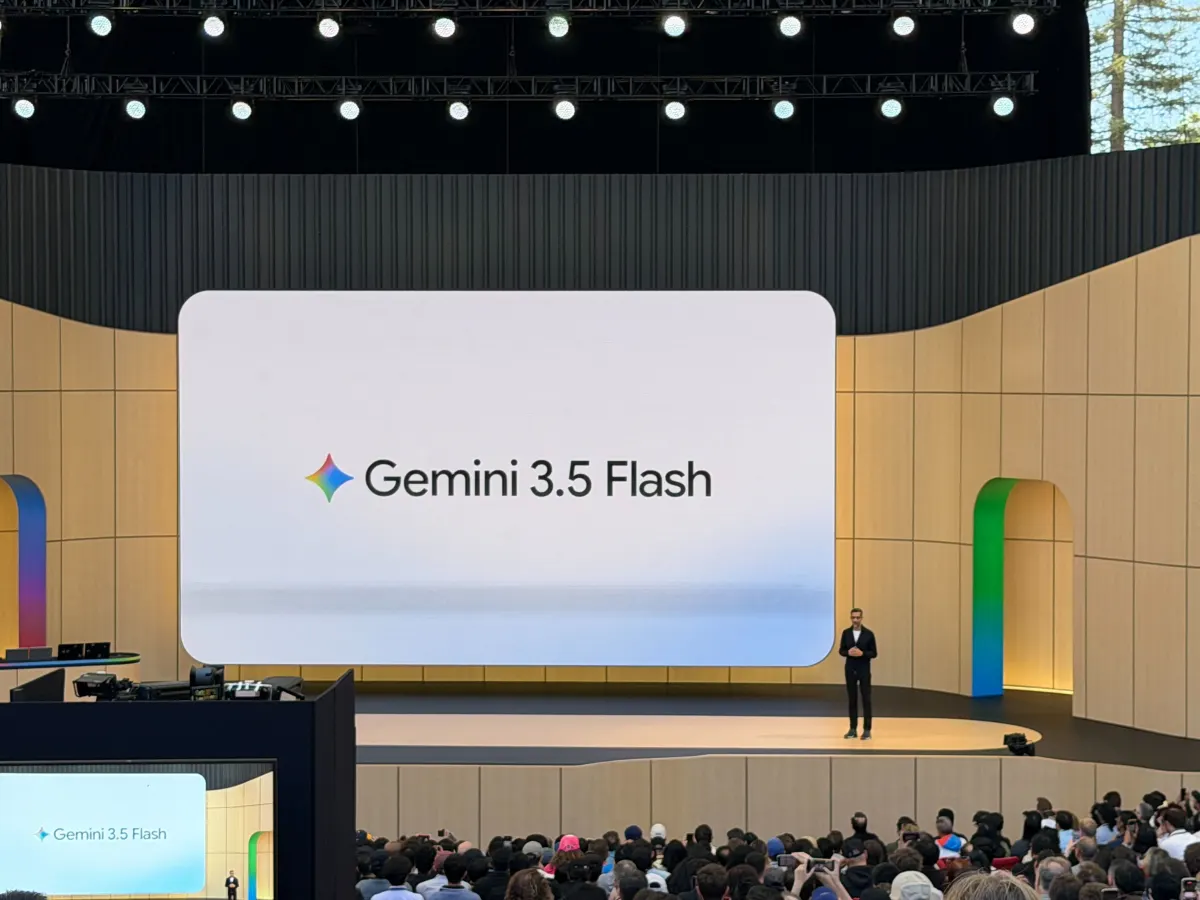
- What is it? Google’s newest Gemini 3.5 Flash is a high-speed AI model optimized for pipelines and autonomous agents, launching Tuesday.
- Performance: It 4x faster than frontier models and has an optimized version 12x faster while matching the quality of the previous Gemini 3.1 Pro.
- Core Feature: It is built for agentic work, enabling AI to spawn multiple workers to handle complex coding and research tasks simultaneously.
- Architecture: Designed co-developed with Google’s Antigravity tool, it functions effectively as a "worker" while Gemini 3.5 Pro acts as the "orchestrator."
- Availability: Widely available today in the Gemini app, Search AI Mode, API, and through Antigravity 2.0.
🎯 Introduction
Google’s latest announcement about Gemini 3.5 Flash marks a pivotal moment in the AI arms race. Following the company’s annual developer conference, Google has introduced an AI model that doesn't just chat—it builds.
While the tech world often focuses on the "intelligence" of a model, Google is betting big on its speed and autonomy. The new Gemini 3.5 Flash is not merely an update; it is a reimagining of AI as a utility engine. From a developer perspective, this release solves the biggest bottleneck of current AI: latency. We are moving past simple LLM interactions toward autonomous "agents" that can maintain state and execute complex workflows faster than a human can click a button.
Here is why the speed of this model matters more than the benchmarks, and how it changes the workflow for developers and enterprises.
🧠 Core Explanation
The fundamental argument Google is making at Google I/O this year is that LLMs need a "workforce," not just a generalist.
Google Gemini 3.5 Flash is designed specifically for high-frequency interactions, coding pipelines, and long-running research tasks. The model's architecture allows it to operate autonomously for hours, pausing only to ask for human guidance on sensitive permissions. This is the direct result of moving AI from a "pull" model (you ask, it answers) to an "agent" model (it proactively manages tasks).
Unlike previous iterations that were updated occasionally, the Gemini 3.5 Flash was co-developed with Google's Antigravity IDE, allowing for a seamless integration where the model feels like a persistent team member rather than a one-off chatbot session.
🔥 Contrarian Insight
"Speed without autonomy is just instant snake oil."
Most tech news will cite the "12x faster" statistic as the headline answer. But here is the nuance: If an LLM is too fast, it hallucinates more volatility. The real win with Gemini 3.5 Flash isn't how fast it generates tokens—it's how well it integrates with the environment.
Google’s decision to split the stack—using a massive "blue sky" reasoning model (Pro) to plan, and a lighter, faster "factory floor" model (Flash) to execute—is the industry's first practical realization of resource allocation in LLMs. We areStop moving away from "Large" to "Right-Sized."
🔍 Deep Dive / Details
Why Google Moved to "Agentic" AI
The release signals a transition from prompting to programming. We are no longer asking models to write a specific function; we are asking them to manage projects.
Koray Kavukcuoğlu, DeepMind’s chief technologist, emphasized that 3.5 Flash offers an "incredible combination of quality and low latency." It outperforms their latest frontier model, 3.1 Pro, on nearly all benchmarks relevant to coding and aggressive task execution.
The Orchestration Strategy: Flash vs. Pro
This is the most critical technical shift for developers. Google isn't replacing Pro; they are complementing it.
- Gemini 3.5 Pro (The Architect): Takes the complex request, creates a plan, and delegates.
- Gemini 3.5 Flash (The Builders): Executes the specific chunks of work (writing code, fetching data, parsing API responses).
In my experience using similar architectures, this separation prevents "token dump syndrome." Pro tries to do everything and gets verbose; Flash does one thing the user asked for but does it reliably and quickly.
Real-World Impact
The model is already being deployed in the wild.
- Banks and Fintechs: Automating multi-week workflows that previously required git-based CI/CD pipelines.
- Data Science: Analyzing complex data environments that are too large for standard chat interfaces.
Safety Context
This launch occurs against the backdrop of a lawsuit regarding a suicide related to chatbot interactions. Google has acknowledged this, stating they have prioritized "safer alignment" for the new model. The system is designed to calibrate refusal answers—avoiding blunt denials while maintaining safety boundaries—allowing for more nuanced handling of sensitive questions.
⚔️ Comparison Section
Flash vs. Pro: What is the Difference?
| Feature | Gemini 3.5 Flash | Gemini 3.5 Pro |
|---|---|---|
| Primary Role | Executor / Worker | Orchestrator / Planner |
| Speed | Extremely fast (12x optimized version available) | Faster than older models, but optimized for reasoning |
| Efficiency | Best for tool-use, coding, and bulk tasks | Best for complex tasks requiring "deep reasoning" |
| Best Use Case | Running multiple agents simultaneously building parts of an OS | Managing one complex project end-to-end |
Self-correction: Think of Flash as the specialized surgeon and Pro as the CEO with medical knowledge.
🚀 Practical Value
How to Access It
You don't need to wait for an invite. Gemini 3.5 Flash is generally available today.
- The Consumer: Open the Gemini app. It is now the default model. It appears in AI Mode in Search for users globally.
- The Developer: It is available via the Gemini API. Use the specific endpoints designed for "agents."
- The Enterprise: Integrated directly into Antigravity 2.0, a new desktop IDE.
What to Build?
If you are building the next AI tool, don't just build a chat interface. Build a dashboard.
- Task Manager Agent: Use Flash to find bugs or refactor code files autonomously.
- Research Agent: Use Flash to scrape and summarize thousands of articles faster than a human can read.
⚡ Key Takeaways
- Agentic First: Gemini 3.5 Flash is not just a faster chat model; it is a designed agent model optimized for autonomous execution.
- Orchestration: The Pro/Flash split creates a powerful "Manager/Worker" architecture for complex software development.
- Speed is a Feature: The optimized version is 12x faster, making long-haul tasks (like building an OS from scratch) technically feasible in minutes rather than days.
- Safety Advances: Google is focusing on calibrating responses to be more helpful without being harmful.
- No Coding Required: Non-developers can now use AI Mode in Search to manage complex workflows via Flash-powered agents.
🔗 Related Topics
- How to Build Custom AI Agents using LlamaIndex (2025)
- The Death of the Prompt Engineer? Why Agentic AI Changes Everything
- Antigravity 2.0 Review: The First IDE Built for AI
- Google I/O 2025: A Developer's Deep Dive into the New Stack
🔮 Future Scope
The integration of Antigravity with Search suggests that "browsing" is becoming background execution. We will likely see the Gemini Spark personal agent become more proactive, suggesting actions rather than just answering questions. The line between "using an AI" and "having an AI team" is about to blur.
❓ FAQ
Q: How fast is Gemini 3.5 Flash really? A: It is roughly 4x faster than other frontier models. Google has a specialized "Flash" version that is 12x faster with equivalent quality.
Q: Can I use it for complex coding tasks? A: Yes. Google claims it outperforms the previous Gemini 3.1 Pro on nearly all coding benchmarks.
Q: What is the difference between Flash and Pro? A: Flash acts as a specialized worker (fast, tool-heavy), while Pro acts as the manager (slow, high reasoning).
Q: Is it available to the public? A: Yes, it is the default model in the Gemini app and AI Mode in Search globally.
Q: What are the safety concerns? A: Google has stated they have strengthened cyber and CBRN (chemical, biological) safeguards to prevent harmful outputs while still being helpful.
🎯 Conclusion
Google’s Gemini 3.5 Flash isn't just faster; it solves the architectural problem of AI scalability. By decoupling reasoning from execution, Google has given developers the tools to build autonomous workflows that actually work in production. The era of the AI chatbot is ending; the era of the AI workstation has begun.
Ready to build? Start experimenting with the new Antigravity IDE today to see the speed difference firsthand.
Share This Bit