ClaudeAI
How to Learn Claude Effectively: A Practical Guide to Mastering AI Tools & Projects
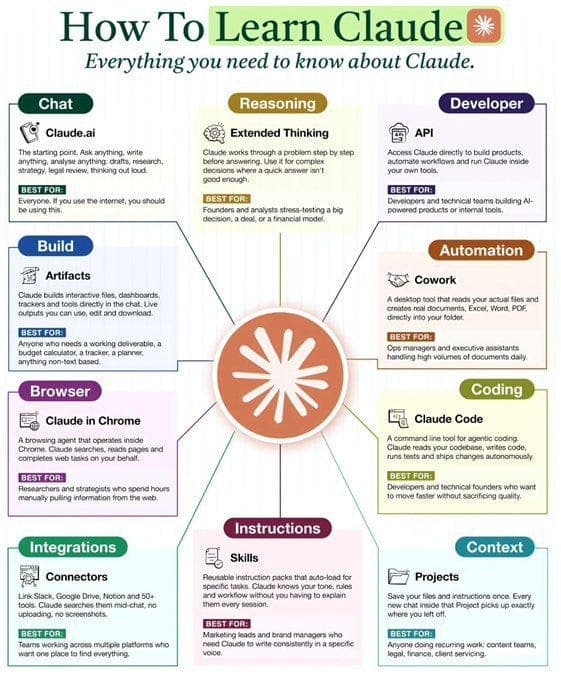
- How to start: Dive into Claude.ai Chat to understand reasoning and general assistance.
- For developers: Use Claude Projects with C4 Strings (e.g.,
.prompt_project.txt) to contextualize codebases quickly. - For automation: Move beyond chat to the Claude API or Prompt Bots for scalable, automated workflows.
- Ultimate Strategy: Treat Claude as a system, not a chatbot. Use Chat for discovery, Projects for organization, and API for execution.
- Keyword: Learning how to learn Claude effectively requires moving from passive prompting to active project building.
🎯 Introduction
Mastering how to learn Claude the right way means moving beyond simple prompting exercises. Most developers waste time guessing prompts instead of understanding the Claude AI ecosystem. To truly master Claude, you must treat it as a multi-modal system involving chat, projects, and automation tools. This guide provides that exact practical roadmap to real-world proficiency.
Most users stop at chatting with the AI. That is the trap. The platform offers three distinct "modes"—Chat, Projects, and the broader toolset. If you only know one, you are not really using Claude.
🧠 Core Explanation: The Three-Layer System
To learn Claude effectively, you must map the tool to the task. Claude is not just a text predictor; it's a context management engine. Here is the breakdown of the system you need to learn:
1. The Chat Layer (The Interface)
This is the entry point. Think of this as the "user experience" layer.
- Best for: Creative writing, brainstorming, quick code snippets, and initial research.
- The "Claude" difference: Unlike ChatGPT, Claude has a large context window and a focus on "slow thinking" (Chain of Thought) where requested. You should learn to toggle between 3.5 Sonnet (Speed) and Opus/4 (Reasoning) based on the complexity of the problem.
2. The Project Layer (The Workspace)
This is Claude’s superpower for developers. Claude Projects allow you to upload a repository, a set of PDFs, or a specific topic and define a "system prompt" or simulation (a .prompt_project.txt). This turns the AI into a consultant for that specific system.
- Why learn this: If you are maintaining legacy code, you don't want to explain the whole codebase every time you ask a question. This layer solves that.
3. The Automation Layer (The Infra)
This is where the "why" changes from curiosity to productivity.
- Best for: Logging into weird APIs, data scraping, local system commands (via Claude Desktop/Client), and LLM-as-a-Service integration.
🔥 Contrarian Insight
Here is the secret most tutorials miss: You should not learn Claude by learning its features; you should learn Claude by learning your own soft skills.
Don't spend time learning "every button." Spend time learning how to write excellent System Prompts and structure your Project Context.
- The Industry Belief: "More technical prompts yield better results."
- The Reality: Claude excels when you strip away rigid constraints and provide nuanced, conversational context. If you have to write 20 lines of complex instructions to get a simple task done, you are likely forcing a hammer to be a drill. Learn to ask Claude to "roleplay" a specific stack or "simulate" a database; it reduces your cognitive load significantly.
🔍 Deep Dive: Implementation & Workflows
Step 1: Adopt the "Project" Workflow
Stop pasting large chunks of text into the chat line.
- Create a new Project in Claude.
- Upload your Source Code Repository (Git).
- Add a Clarifying Instruction (e.g., "You are a Senior Architect reviewing this code for security vulnerabilities and scalability issues").
- Result: Claude now knows your codebase.
Step 2: Use C4 Strings (File Context)
Developers love efficiency. The best way to learn Claude is to alias Common Context Files.
Create a file in your root repository named .prompt_project.txt. Inside, write your "Constitution" or "Persona."
- Example:
# Project Context: BitAPI Gateway
You are an expert in Node.js, Express, and AWS Lambda.
Avoid deprecated async/await patterns.
Always check for rate limiting headers before suggesting API calls.
Step 3: Enable Native Automation (No-Code)
Don't always build a script.
- How: Go to
claude.ai/promptsor use "Prompt Bots" in the Claude Desktop app. - Action: Create a bot that says: "Run this code in the browser and tell me if it fails." Or "Generate a daily summary of my Jira tickets and send them to Slack."
- Learning Value: This teaches you how to construct conversation flows that result in actions rather than text.
🏗️ System Architecture: How Claude "Understands"
If you are building things with Claude, you need to understand the inputs.
- Context Injection (RAG-lite): Claude looks at what you upload or generate in the chat history. The "Project" layer allows you to inject a static JSON or Text file as a base context.
- Token Budget Management: Claude has a hard limit (usually 200k, though usually, "Projects" allows for massive context files that are streamed in).
- Model Routing: When you ask a question, Anthropic's infra chooses the best model (Sonnet vs Opus) for that specific token payload automatically.
⚔️ Claude vs. The Rest (Quick Comparison)
| Feature | Claude | ChatGPT (OpenAI) | Copilot (MS) |
|---|---|---|---|
| Context Window | Massive (200k+) | Large (128k neon) | Context-aware |
| Best for | Reasoning, Long Docs, Artistic writing | General purpose, Coding (specific) | Inline code completion |
| Voice/Speed | Very fast to type, internal reasoning is deep | Fast generation | Instant "Line-by-line" |
| Cost | Pricing model similar to GPT-4 | Pricing model similar to Claude 3 Opus | Included in MS Sub |
🧑💻 Practical Action Plan
In my experience, the fastest way to curve is to do a "System Refactor" on an old project.
- Pick a legacy project (at least 1k lines of code).
- Upload it to a Claude Project.
- Run
claude.sh(CLI tool) and ask: "Find all TODO comments and solve the top 3 security vulnerabilities." - Review the code changes Claude suggests against your own standards.
Mistake to Avoid: Do not blindly copy-paste code from Claude. Always read it. Claude hallucinates APIs just like any other model; treat it as a Junior Developer that needs your Code Review.
⚡ Key Takeaways
- Shift mindset: Don't just chat; Contextualize. Use Projects to feed Claude your data.
- Leverage Files: Use
.prompt_project.txtto define system constraints easily. - Choose the Model: Use 3.5 Sonnet for speed/coding and Opus/4 for complex strategy/reasoning.
- Automation: Use Prompt Bots to create automated workflows for repetitive tasks.
🔗 Related Topics
- Mastering Claude 3.5 Sonnet: The New Coding State of The Art
- How to use Claude Project Files (C4s) for Large Codebases
- The Ultimate Guide to Claude API Integration with Node.js
- Why Anthropic's Constitutional AI Beats Free-Range Prompts
🔮 Future Scope
Expect Claude to move further into "Agents". In the coming year, learning Claude will involve learning how to orchestrate multiple Claude instances to act as a team (e.g., one for analysis, one for coding, one for testing). Keep your focus on learning Project File structures, as that will be the core UI for these super-agents.
❓ FAQ
Q: Is Claude better than ChatGPT for programming? A: It depends. For writing new code, ChatGPT is often more battle-tested in specific frameworks. However, Claude is significantly better at reading and refactoring existing large codebases due to its superior context handling in Project mode.
Q: How does the "Max" limit work? A: Using the paid products, Claude offers "Max" mode which essentially pays for you to use the top-tier models for cheaper throughput. For learning, you can stick to free tier Sonnet—understanding the limitations helps you learn better.
Q: Can I use Claude offline? A: Yes. You can use Claude Desktop, which uses local storage and context, or run local inference models (like Llama 3) that mimic Claude’s style if you have the hardware.
🎯 Conclusion
How to learn Claude is not a question of memorizing buttons; it is a question of learning to organize information. By moving from Chat to Projects, and finally to Automation, you transform from a user to a creator. Build your workflow. Automate your grunt work. Claude is the engine; you are the programmer.
Ready to build? Start your first Project today and try to refactor a single file without leaving the conversation window.
Share This Bit