AIAnthropic
HTML vs Markdown: The War Is Over (Here's Your Decision Tree)
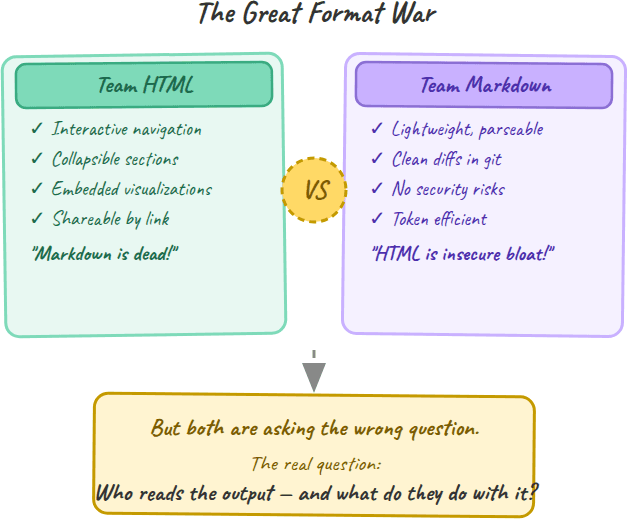
- Markdown is superior for agent-to-agent workflows and version control due to smaller file sizes, easier diffing, and lower token overhead. Use it for inputs, repos, and data pipelines.
- HTML is superior for human interaction with AI output, offering interactive components, better navigation, and shareable views (especially at the 2,000+ word mark).
- The Hybrid Model (Markdown source + HTML artifact) is the production standard for most development teams using AI agents like Claude or GitHub Copilot.
🎯 Introduction
The HTML vs Markdown debate has resurfaced with high stakes after Anthropic's lead engineer, Thariq Shihipar, published "The Unreasonable Effectiveness of HTML." After generating 20 interactive examples, his post flooded social media with views, forcing developers to choose a side. Is Markdown dead? In this guide, we analyze the technical trade-offs, the hidden costs of token math, and the security implications of AI-generated code.
🧠 Core Explanation
Markdown won because it solved the "text-to-web" problem for humans. It was designed by John Gruber in 2004 to convert plain text to HTML easily. GitHub popularized it for READMEs, and eventually, it became the default for Notion, Obsidian, and—crucially—AI training data. When OpenAI trained GPT-4, it "saw" markdown everywhere, so it spoke markdown.
However, the agent era has shifted the problem.
- Capacity: Context windows are 128,000+ tokens. We no longer need to compress text aggressively.
- Interactivity: A 2,000-line code review or architectural decision matrix is hard to read in a raw flat file. Humans need navigation.
- Human vs Machine: Markdown is a file format designed for humans to edit with a cursor. HTML is an interface designed for humans to operate with a browser.
🔥 Contrarian Insight
"The Token Trap" is the industry's biggest distraction. We waste hours arguing whether switching to HTML costs an extra $5/month in API bills (which is negligible at scale), when the real cost is human intelligence. A senior engineer spending 15 minutes manually filtering a broken Markdown wall—seconds to solve in an interactive HTML artifact—represents a hidden operational loss of $20+ per task. Don't save pennies to burn dollars in engineering hours.
🔍 Deep Dive / Details
Why Markdown’s 3 Assumptions Have Broken
Markdown assumed the user workflow in 2004: Write -> Render -> Read. Three things broke this in the AI age.
- No Human Editing of AI Output: Developers don't edit AI-generated text in VS Code; they often share it or copy-paste it into other tools.
- Screen Size Limits: Chat interfaces handle high density, but saved Markdown files over 100 lines become unreadable walls of text.
- Read-Only Format: Modern workflows involve a feedback loop (Agent generates -> Human interacts -> Agent fixes). Markdown cannot be changed or filtered easily after generation.
The Math: Is HTML Actually 5x More Expensive?
Yes, technically. Generating a rich HTML artifact with inline styling (using Tailwind via CDN or font CSS) consumes approximately 3–5x the tokens compared to plain Markdown.
- Tailwind/Bootstrap HTML: ~1 token per character (standard HTML/CSS).
- Markdown: ~0.2 token per character.
The Cost Breakdown:
- Individual: ~$0.17 per expensive report. This is negligible compared to your electricity or coffee.
- Enterprise (10k reports/mo): This costs ~$17,000/month in token overhead.
- The Trade-off: At enterprise scale, the "$0.17" is real money. However, if your senior engineer saves 4 hours of parsing time per report (valued at ~$100/hr), you have mathematically outperformed the cheap solution.
security Risks of AI-Generated HTML
Team Markdown has a valid point: HTML introduces new vectors.
- XSS (Cross-Site Scripting): AI models can insert malicious
<script>tags. - Extraneous Dependencies: AI might inject unpkg or Cloudflare scripts that violate company security policies.
- The Fix: Do not run AI-generated HTML in your primary VPC or production debugger without strict sandboxing, or prompt explicitly: "Generate HTML with NO JavaScript, NO external CDNs, and NO interactive widgets."
🏗️ System Design / Architecture
In a modern AI-powered dev environment, the architecture should look like this:
- The Store (Source of Truth): Always Markdown. Keep git-tracked, version-controlled, and easily diffed. This is the "trainable" data for future models.
- The Worker (Generation): Your LLM (Claude/GPT) generates the output. If the output is >2000 tokens, instruct it to output Markdown + HTML code block.
- The Renderer (Presentation): A lightweight Node.js or Python microservice renders the HTML artifact.
- The Vault (Artifact): The HTML artifact is archived in the repo alongside the Markdown source.
Template + Data Pattern for Diffs
To avoid "noisy diffs" in Git (where a one-character change causes 100 lines of markup diff), use the Template Pattern:
index.html: The base HTML structure (buttons, styles).data.json: The content injected by the AI.- Why? You only diff the JSON file. The HTML remains a static artifact.
⚔️ Comparison Section
| Feature | Markdown | HTML (Rich) | Verdict |
|---|---|---|---|
| Token Overhead | Low (Legacy) | High (3-5x) | Markdown for Inputs |
| Navigation/Scrolling | Poor (flat text) | Excellent (anchors, sections) | HTML for Views |
| Version Control (Diffing) | Clean (text-based) | Noisy (markup-heavy) | Markdown for Repo |
| Interactive Components | None | Yes (Buttons, collapsibles) | HTML for UX |
| Security (XSS) | Low | Medium (Risk of scripts) | Markdown |
🧑💻 Practical Value
The Decision Tree Implementation
Do not choose one format for everything. Here is a production-ready heuristic:
Scenario A: Code Review or Architectural Decision Record (ADR)
- Verbose and hierarchical
- Output: HTML Artifact
- Why: You need severity colors, collapse details, and easy navigation for stakeholders to read on Slack or Jira views.
Scenario B: Logfiles or Database Dump Analysis
- Input or Data Processing
- Output: Markdown (JSON/TSV)
- Why: You need to parse this data with Python scripts or feed it to another agent. Text is easier to chunk.
Scenario C: Final Design System Specs
- Visuals and Comparisons
- Output: HTML/React Preview
- Why: Developers need to click through variants to make decisions.
Prompt Engineering for Safe HTML
If using Claude Code to generate HTML artifacts, use this system prompt snippet:
"Generate an HTML report regarding [Topic]. Constraints:
- Verify NO inline JavaScript.
- External CSS must be avoided (use system fonts).
- Ensure accessibility tags are present.
- Wrap the output in a
<pre>block for code display."
⚡ Key Takeaways
- Markdown is not dead, it's being demoted. It stays as the data layer (repo input), not the presentation layer.
- Token savings are negligible for humans. A $0.17 API cost increase saves $100+ in human rewriting time.
- Security requires guardrails. AI-generated HTML is unsecured by default; disable JavaScript in prompts.
- The Architecture Profits (incentives). Note that Anthropic profits from higher token usage (HTML), so be aware of vendor lock-in when adopting interactive dashboards.
🔗 Related Topics
- Integrate Claude Code: The Complete Setup Guide
- Optimizing Token Costs: The Math Behind Enterprise LLM Usage
- Static Site Generators Explained: Jekyll vs Hugo
🔮 Future Scope
As context windows continue to expand, the primary constraint shifts from "token economy" to "information architecture." We will see the rise of AI-native formatting—formats that are neither Markdown nor HTML, but specifically optimized for vector search and agentic retrieval (e.g., Structured Protobufs, RDF, or JSON5 attached to documents). However, for the immediate future, the Markdown + HTML hybrid remains the pragmatic standard.
❓ FAQ
Q: Does HTML consume 3-5x more tokens? A: Yes, on average. A richly styled HTML document containing JavaScript and CSS approximately equals 4–5 times the token count of its Markdown equivalent because HTML tags and CSS rules are less compressible than Markdown shorthand.
Q: Is it safe to run AI-generated HTML locally?
A: Not by default. If you use tools like Claude Code to generate .html files, you should treat them like downloaded attachments rather than installed files. Always strip scripts or render them in a sandboxed browser environment.
Q: Why did Anthropic push for HTML? A: From an API business perspective, HTML generates higher volume. It also creates a superior user experience ("Delight"), which increases stickiness to the platform. From a technical perspective, it solves the UX problem of 2,000+ word AI reports.
Q: Can I use Markdown for the web in 2026? A: Yes, static site generators like Jekyll, Hexo, or Astro have nearly zero-cost formatting entirely in Markdown. You are not forced to use HTML if you are writing blogs; however, for interactive tooling built by AI agents, HTML is currently the only viable path.
🎯 Conclusion
The HTML vs Markdown war is a false dichotomy. The debate is not about which format renders text better; it is about which format solves the workflow problem. As AI agents become the primary creators of technical output, we must stop optimizing for the 2004 text editor and start optimizing for the 2026 web interface. Adopt the hybrid approach: keep your repo in Markdown, and generate specific HTML artifacts for the humans who need to read and interact with the data.
Share This Bit