AI appsMCPAIModel Context ProtocolAI Agents
Model Context Protocol (MCP) Explained: The HTTP of AI Agents?
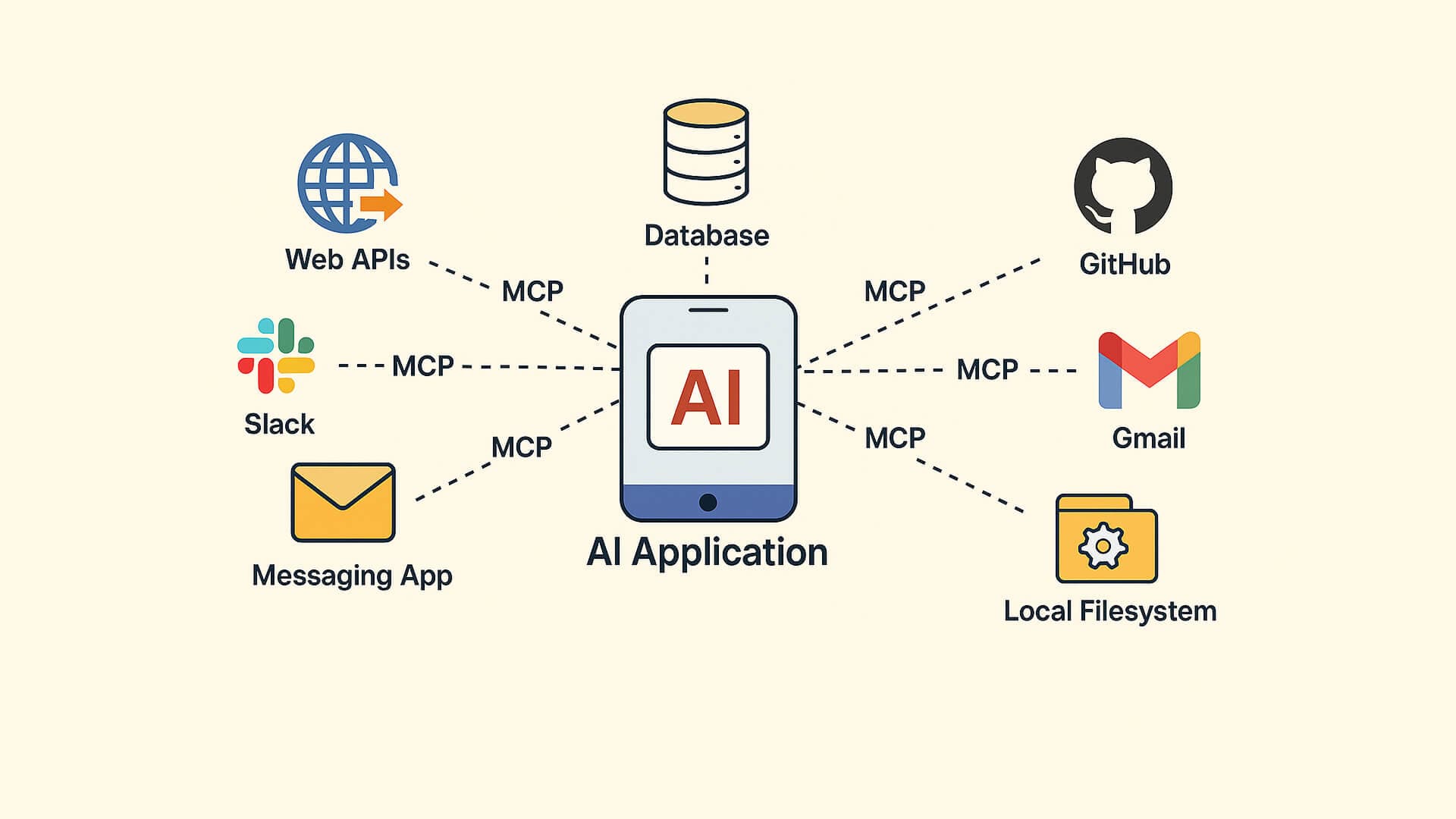
- Model Context Protocol (MCP) is an open standard that allows AI models to connect with tools, databases, APIs, and external systems using a common interface.
- MCP reduces custom integrations by providing a standardized communication layer between AI agents and services.
- Many AI ecosystems are adopting Model Context Protocol as a universal way to give AI agents access to real-world data and actions.
- MCP enables developers to build tools once and make them available across multiple AI applications.
- Some developers describe MCP as the "HTTP of AI Agents" because it standardizes how AI systems discover and interact with external capabilities.
🎯 Introduction
If you've been building AI agents recently, you've probably heard about Model Context Protocol (MCP). The Model Context Protocol is rapidly becoming one of the most important standards in AI infrastructure because it solves a growing problem: every AI application needs access to tools, APIs, databases, documents, and business systems.
Today, developers often create custom integrations for every AI model and every tool. This approach doesn't scale. Model Context Protocol aims to solve that challenge by providing a universal protocol that allows AI agents and external systems to communicate in a standardized way.
As AI agents become more powerful, MCP could become the foundation that connects models to the real world.
🧠 What Is Model Context Protocol (MCP)?
Model Context Protocol (MCP) is an open protocol designed to standardize how AI models interact with external resources.
Think of MCP as a connector layer between:
- AI Models
- AI Agents
- APIs
- Databases
- File Systems
- SaaS Applications
- Internal Enterprise Tools
Instead of creating a separate integration for every tool, developers can expose capabilities through MCP.
The AI model then discovers and uses those capabilities through a consistent interface.
Simple Definition
Model Context Protocol (MCP) is a standardized way for AI systems to access tools, data, and actions from external services.
This is why many engineers compare MCP to HTTP.
HTTP standardized communication between browsers and servers.
MCP aims to standardize communication between AI agents and external systems.
Why MCP Exists
Developers often struggle with integration complexity.
Without MCP:
- Every AI app requires custom tool integrations
- Different AI providers use different formats
- Maintenance costs grow rapidly
- Agent portability becomes difficult
Imagine supporting:
- OpenAI
- Anthropic
- Local LLMs
- Enterprise AI platforms
Each may require different integration methods.
MCP introduces a common layer that reduces fragmentation.
🔥 Contrarian Insight
Most people think the future of AI will be determined by better models.
That may be wrong.
The biggest bottleneck isn't intelligence anymore—it's connectivity.
The AI companies that win may not be the ones with the smartest models.
They may be the ones with the largest MCP-compatible ecosystem.
Quote:
"The next AI platform war won't be about models. It will be about who owns the protocol connecting models to the real world."
🔍 Deep Dive: How MCP Works
At a high level, MCP introduces three major components:
1. MCP Host
The application running the AI model.
Examples:
- AI IDE
- Chat application
- Coding assistant
- Enterprise AI platform
2. MCP Client
Responsible for communicating with MCP servers.
Functions:
- Discover available tools
- Request resources
- Execute actions
- Transfer context
3. MCP Server
Exposes capabilities to AI systems.
Examples:
- GitHub Server
- PostgreSQL Server
- Slack Server
- CRM Server
- Custom Business Tools
MCP Architecture
+-------------------+
|    AI Agent       |
+-------------------+
          |
          v
+-------------------+
|    MCP Client     |
+-------------------+
          |
          v
+-------------------+
|    MCP Server     |
+-------------------+
      /   |   \
     /    |    \
    v     v     v

 GitHub  Database  Slack
   API      API     API
The AI agent interacts only with the MCP layer.
The MCP layer handles external communication.
MCP vs Traditional APIs
| Feature | Traditional APIs | MCP |
|---|---|---|
| Human Designed | Yes | No |
| AI Native | No | Yes |
| Tool Discovery | Manual | Automatic |
| Context Sharing | Limited | Built-in |
| Agent Friendly | Partial | Full |
| Multi-Model Support | Difficult | Easier |
Here's the Catch
MCP does not replace APIs.
APIs remain the underlying infrastructure.
MCP sits on top of APIs and provides a standard AI-friendly interface.
Think of it as:
Application Layer
      ↓
MCP Layer
      ↓
API Layer
      ↓
Business Systems
Why Developers Are Adopting MCP
Faster Integrations
Build once.
Expose through MCP.
Use across multiple AI applications.
Better Agent Portability
Agents become less dependent on a specific platform.
Reduced Maintenance
A standardized protocol means fewer custom integrations.
Growing Ecosystem
The number of MCP servers is growing rapidly.
Developers can reuse existing integrations rather than building everything from scratch.
🏗️ MCP and the Future of AI Infrastructure
In real-world usage, most AI agents fail because they cannot reliably interact with external systems.
Models are becoming smarter.
The challenge is giving them safe and scalable access to:
- Business data
- Enterprise applications
- Developer tools
- Cloud platforms
- Internal knowledge bases
MCP directly addresses this challenge.
Future AI architectures may look like:
User
 ↓
AI Agent
 ↓
MCP Gateway
 ↓
MCP Servers
 ↓
Enterprise Systems
This architecture allows organizations to control access while giving agents powerful capabilities.
🧑💻 Practical Value: How Developers Can Start Using MCP
Step 1
Learn MCP concepts:
- Hosts
- Clients
- Servers
- Resources
- Tools
Step 2
Install an MCP-compatible AI environment.
Step 3
Connect existing MCP servers.
Examples:
- GitHub
- PostgreSQL
- File Systems
- Documentation Sources
Step 4
Build a custom MCP server.
Expose:
- Internal APIs
- CRM data
- Analytics systems
- Business workflows
Step 5
Test agent workflows across multiple AI platforms.
⚔️ MCP Alternatives
Direct Function Calling
Pros:
- Simple
- Fast
Cons:
- Vendor lock-in
- Limited portability
Custom Tool Frameworks
Pros:
- Flexible
Cons:
- High maintenance
MCP
Pros:
- Standardized
- Reusable
- Ecosystem-driven
- Multi-platform
Cons:
- Still evolving
- Early-stage ecosystem
For most organizations building long-term AI infrastructure, MCP is becoming the most attractive option.
⚡ Key Takeaways
- Model Context Protocol is becoming a foundational AI integration standard.
- MCP standardizes communication between AI agents and external systems.
- MCP does not replace APIs; it enhances them.
- Developers can build tools once and expose them across multiple AI platforms.
- AI ecosystems are increasingly adopting MCP.
- Enterprise AI architectures are likely to rely heavily on MCP-like standards.
- MCP could become the "HTTP of AI Agents" over the next few years.
🔗 Related Topics
- Building AI Agents with MCP: Complete Developer Guide
- MCP vs Function Calling: Which Should Developers Use?
- How to Build a Custom MCP Server from Scratch
- AI Agent Architecture Explained for Software Engineers
- The Future of AI Infrastructure Beyond APIs
🔮 Future Scope
The next phase of AI development is not simply better models.
It is better connectivity.
As organizations deploy more autonomous AI agents, protocols like MCP will become increasingly important.
Expect:
- More MCP servers
- Enterprise adoption
- Cross-platform interoperability
- Standardized AI ecosystems
By 2026 and beyond, MCP could become one of the most important infrastructure layers in modern AI systems.
❓ FAQ
What is Model Context Protocol?
Model Context Protocol (MCP) is an open standard that enables AI systems to access tools, resources, and external services through a common interface.
Why is MCP compared to HTTP?
HTTP standardized communication between websites and servers. MCP aims to standardize communication between AI agents and external systems.
Does MCP replace APIs?
No. MCP sits on top of APIs and provides an AI-friendly abstraction layer.
Is MCP only for AI agents?
Primarily yes. MCP is designed specifically to help AI systems interact with tools and data sources.
Should developers learn MCP now?
Yes. MCP adoption is growing rapidly and is becoming an important skill for AI engineers and agent developers.
🎯 Conclusion
Model Context Protocol is one of the most important developments in AI infrastructure today.
While large language models continue improving, the real challenge is connecting those models to the systems where valuable data and actions exist. MCP provides a standardized solution to that problem.
For developers building AI agents, learning MCP now could provide a significant advantage as the ecosystem continues to grow. If HTTP shaped the internet era, MCP may help shape the era of autonomous AI agents.
Share This Bit