AITechnologyRoboticsAI Agents
The General Purpose Robot Brain: Why the new Physical Intelligence pi0.7 Model is a Dev-First Inflection Point
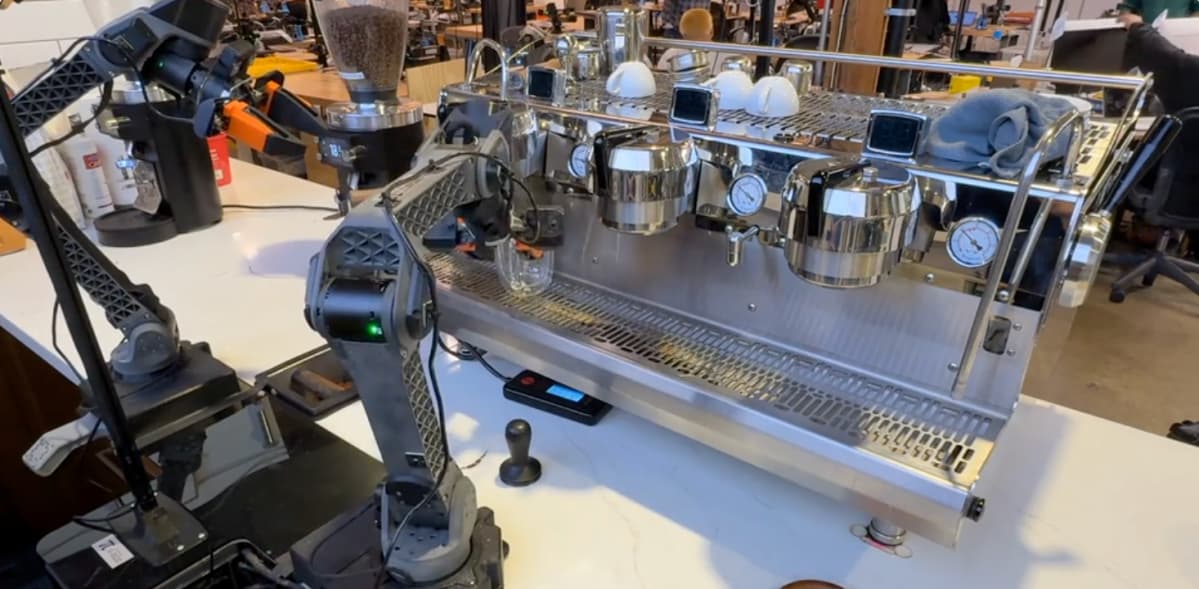
The General Purpose Robot Brain: Why the new Physical Intelligence pi0.7 Model is a Dev-First Inflection Point
🚀 Quick Answer (Featured Snippet)
- The Core Claim: The new Physical Intelligence pi0.7 model demonstrates compositional generalization, breaking the "rote memorization" cycle of robotic training.
- Real-World Proof: It successfully operated an air fryer with only two examples in its training dataset by synthesizing broader web-based knowledge.
- The Inflection Point: This represents a shift from "specialist models" (task-specific) to a true general purpose robot brain capable of remixing learned primitives.
- Developer Impact: High-level commands now require detailed prompt engineering, as the model needs specific "step-by-step" coaching to handle multi-step tasks autonomously.
🎯 Introduction
In the rapidly evolving landscape of robotics, Physical Intelligence pi0.7 is a significant departure from previous specialized efforts. By demonstrating compositional generalization, this new model solves a problem AI engineers have struggled with for years: how to move beyond rigid, data-specific constraints. This isn't just a toy demo; it is the first concrete proof that we are building a general purpose robot brain capable of reasoning about physical interactions it was explicitly never trained to understand.
🧠 What is Physical Intelligence pi0.7?
The pi0.7 model is a foundational model designed for robotic manipulation. Unlike traditional pipelines where you collect data for "coffee making," train a model for coffee making, and repeat for "folding towels," pi0.7 is trained on a vast corpus of continuous locomotion and manipulation data.
It uses a State Space Transformer (SST) architecture to map high-dimensional state spaces. In plain English: it treats the robot's sensor data and the physics of the world as a language it can learn to parse and generate. The model doesn't "memorize" the kitchen; it learns relationships between physics, objects, and goals.
🔥 Contrarian Insight
"We are obsessed with the 'Flip' because it's cool. The General Purpose Robot Brain is defined by 'Folding Laundry' because it works."
The industry is obsessed with choreographed stunts (backflips, parkour). However, the Physical Intelligence team argues that this obsession is misleading. Boring utility is significantly harder than impressive stunts. The fact that pi0.7 can "fail gracefully" and "prompt engineer itself" (via human coaching) into success is a far more significant engineering milestone than a one-time viral video. We are solving the wrong problem if we judge robot brains by their entertainment value rather than their semantic utility.
🔍 Why This Matters in 2026
As we move toward 2026, the gap between "simulated potential" and "real readiness" is closing. pi0.7 suggests that robotic AI is approaching an inflection point similar to Large Language Models (LLMs): where capabilities begin to compound.
This matters for developers because the cost of deployment drops. You no longer need a dedicated sensor rig and data collection team for every new task. Instead, you need a robust foundation model and a high-quality "interpreter" (the prompts). This changes the devops workflows of robotics startups entirely.
⚔️ Comparison / Alternatives
To understand the value of pi0.7, we must contrast it with the industry standard in 2024.
| Feature | Specialist Models (Legacy) | Physical Intelligence pi0.7 |
|---|---|---|
| Training Data | Task-specific (narrow) | Broad/Large-scale Continuous Action (Wide) |
| Deployment | High maintenance (retraining for change) | Low maintenance (fine-tuning) |
| Capability | "Do this specific motion" | "Understand why this motion works" |
| Failure Mode | Total crash on new task | Error correction + User coaching |
🏗️ How It Works (Technical Deep Dive)
The underlying mechanism of pi0.7 relies on Compositional Generalization. Here is the technical breakdown of how it goes from "unknown" to "working":
- State Space Embedding: The model converts raw sensor data (camera feeds, joint angles) into a compressed state representation. It looks at the shapes of objects (e.g., "curved handles," "flat surfaces") rather than just memorizing pixel grids.
- Primitives Synthesis: Researchers noted that the model had seen an air fryer closed (pushed) and plastic bottles placed in it. It didn't know the causal relationship between them beforehand.
pi0.7synthesized these into a "handle-object-closure" primitive. - Semantic Grounding: The model connects the instruction to the primitives. "Open the air fryer" maps to "Move hand to handle -> Apply torque to close -> Observe safety lock release."
- Iterative RL (Reinforcement Learning): In the 5% failure cases mentioned in the research, the model likely fails to map the instruction to the primitive initially. Corrected by human feedback, it updates its internal mapping, converging to the 95% success rate.
🧑💻 How Developers Can Use This (ACTIONABLE)
You cannot deploy pi0.7 out of the box today, but you can prepare your infrastructure for the "Foundation Model" era of robotics.
- Shift from Controls to Prompts: Design your applications around natural language control. Create a library of semantic prompts (e.g., "Tidy the desk," "Wrap this gift") rather than defining actuator coordinates.
- Build the "Coaching" Interface: The researchers found that stepping through the task (acting as a senior engineer to a junior) directly correlates with success. Build a "rubber ducking" interface for robots.
- Metadata is Key: The model's ability to generalize is heavily dependent on dataset quality. Ensure your training data comes from high-fidelity physics simulations to help the AI distinguish between "stable" and "unstable" object states.
🧪 Real-World Use Case: The Air Fryer Experience
The most cited example involves a robot attempting to cook a sweet potato. The dataset contained:
- A robot pushing an air fryer closed.
- Another robot placing a plastic bottle inside an air fryer.
The model had zero experience cooking food. Yet, when asked to use it, it constructed the task: Find handle -> Rotate -> Verify tight seal -> Check heat setting.
When the task failed (due to "prompt engineering" gaps), researchers broke the task down:
- "Step 1: Approach."
- "Step 2: Grip." The success rate jumped immediately. This proves the model possesses the knowledge; the developer just needs the right instruction set.
⚡ Best Practices & Mistakes
- Don't write rote code: If you are hard-coding trajectories, you are using the architecture from 2015. Rely on the model's continuous learning, not hardcoded logic.
- Prompt Engineering is Non-Negotiable: As the researchers admitted, "5% success rate" is unacceptable for production. Invest heavily in your system prompt and instruction tuning.
- Mental Model Check: The model is strong at geometry and motion planning, but weak at intent understanding until prompted explicitly.
🔗 Related Topics
- Semantic Robotics: Why Understanding Meaning Beats Pixel Perfect Accuracy
- Foundation Models for Robotics: Using Behind-the-Scenes Data Strategy
- Prompt Engineering for Robots: A Developer's Guide to Human-in-the-Loop
- State Space Transformers (SSTs) Explained: The Future of AI State
- Autonomous Generalization: Moving from Static Training to Dynamic Adaptation
🔮 Future Scope
If the current trajectory holds, we will see a bifurcation in the market:
- Enterprise 工业 4.0: Companies adopt these foundation models to retrofit existing fleets of industrial manipulators, increasing ROI without buying new hardware.
- Consumer Robotics: Devices that "learn your apartment" and handle chores without factory recalibration.
The "General Purpose Robot Brain" is still in its alpha phases, but the signal is clear: The era of task-specific scripts is ending.
❓ FAQ
Q: Do I need billions of dollars in servers to train pi0.7?
A: No. Physical Intelligence did this on a specific benchmark. As these models open-source (like LLMs), we will likely see smaller, fine-tuned versions running on NVIDIA Jetson Orin Dev kits within 18-24 months.
Q: What exactly is compositional generalization? A: It is the ability to apply skills learned in one context (using a bottle as a weight) to a completely new, unrelated context (using a book as a weight) for a different goal (stacking).
Q: Why does the model succeed only after human coaching? A: The robot lacks semantic world knowledge (knowing that "frying" implies heat, safety, and time). It understands "motion," but not "cooking." The human bridges this gap via natural language.
Q: Is pi0.7 safer than older models?
A. Not necessarily regarding collision (learning from failure is hard). However, it is potentially safer regarding adaptability, as it can stop attempting a task if a new object doesn't fit the expected motion profile.
Q: When can I buy a robot powered by this? A. Physical Intelligence hasn't announced consumer products yet. The technology is currently being deployed via partnerships in warehouses and hospitality (likely handling bags or food trays).
🎯 Conclusion
The Physical Intelligence pi0.7 release is a benchmark moment. It decouples robot intelligence from hardcoded training data. For developers, the takeaway is a shift in mindset: stop treating every robot as a closed system built for a single script, and start building architectures that allow the robot to understand the room it is in. The air fryer demo may look like a party trick, but the ability to remix learned physics is the architecture of the future.
BitAI Editorial Note
To stay ahead of the curve in Robotics AI, subscribe to our newsletter for analysis on the next wave of foundation models.
Share This Bit