ThreadsMeta
Threads Web DMs Finally Arrive: Meta's Latest Platform Shift
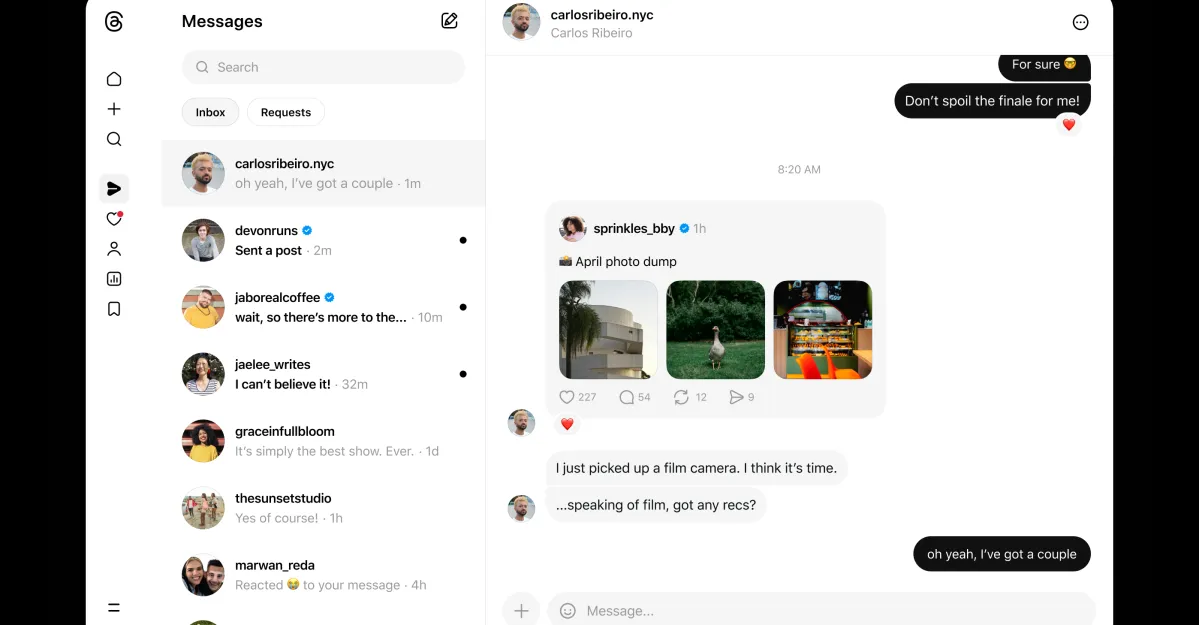
- What is happening: Meta is now testing Threads web DMs on the desktop browser interface.
- How to access: Users with access can navigate to the "Dm" tab in their sidebar; no redesign of the mobile app is required.
- Current Status: It is in a limited test phase, with a wider rollout planned "soon."
- Key Feature: You can control who can DM you (Any user vs. Followers only), just like on mobile.
🎯 Introduction
Nearly a year after rolling out direct messaging to every Threads user on mobile, Meta is finally bringing Threads web DMs to the browser. This long-awaited feature addresses a major user demand: the ability to pivot from a scrolling feed to a sidebar conversation without shifting context to a mobile device.
For power users and developers who prefer the precision of keyboard input and screen real estate, this shift validates Threads as a productive tool, not just a social feed.
🧠 Core Explanation: What Changed?
Meta has confirmed that direct messaging on Threads is entering a broader testing phase on the web. This isn't just a UI tweak; it represents a strategic pivot for the app toward "Desk-First" productivity.
According to Connor Hayes, Head of Instagram and Threads, the reasoning is simple: engagement.
"Our most engaged people spend time on web because they’re at their desks, tapped in, using Threads for longer sessions."
The current capabilities include:
- Inbox Management: View all unread messages and message requests.
- Privacy Controls: Toggle settings to let "Anyone" DM you or restrict it to "People you follow."
- Group Chat Testing: A new feature currently available on mobile is being replicated for the web.
🔥 Contrarian Insight
The "one-click" fix isn't enough.
Don't expect Threads to kill Facebook Messenger just by cloning the UI on the web. The mistake Meta is making (a common trap in tech) is treating the "Desktop" experience as a scaled-down version of "Mobile."
Mobile users are scrolling for dopamine hits. Desktop users want utility. If Threads web DMs don't offer a fast text-input mode, keyboard shortcuts, and API integrations, it will remain a feature, not a replacement. The Web version needs to feel like Slack, not Instagram.
🔍 Deep Dive / Tech Analysis
Why Now?
The delay (nearly a year) was likely due to backend synchronization. Threads runs on the same Rally architecture that powers Instagram. Integrating a separate, ephemeral communication layer (DMs) requires tighter coupling between the message queue and the notification system.
For developers, this means the API will likely see a surge in "get_conversation_history" and "update_message_timestamp" endpoints.
The UI Shift
Previously, the web feed was clean but isolating. The addition of the "DM" tab creates a split-vision interface. This mirrors competitor X (Twitter), which utilizes sidebar navigation for tweets and DMs simultaneously.
This shift increases platform stickiness. It’s harder to leave a chat window open than it is to just close a tab.
🏗️ System Design Implications (Developer Perspective)
If you are building against the Threads API, this feature rollout signals an expectation for higher data frequency.
1. Real-Time Updates
- Trade-off: Handling WebSockets or polling at a high frequency for a massive user base creates bandwidth strain.
- Mitigation: Meta likely uses a "lazy load" strategy where messages are fetched on demand rather than pushed to the UI instantly unless it's a reaction to a post.
2. State Persistence
- Challenge: Web DMs must persist state across device tabs or browsers.
- Architecture: This requires caching the last accessed message index in local storage or session storage so the user returns to the right spot (linear conversation) rather than the latest message in the stack.
🧑💻 Practical Value & Action Plan
What should you do right now?
- Check Your Access: If you are in the test group, look for the "DM" icon in the left or top navigation rail on
threads.net. - Test the Logic: As a developer using Threads, test your mobile push notifications against the web interface. Ensure your "Message Requests" settings aren't accidentally blocking your own test threads.
- Privacy Settings: If you are open for business, ensure your "Who can DM you" setting is set to "Everyone" on the web if you want to minimize friction.
⚔️ Comparison vs. Competitors
| Feature | Threads Web DM | X (Twitter) Web DM | Threads (Mobile) |
|---|---|---|---|
| Integration | Dedicated Sidebar Tab | Requires "More" menu click | Native Tab |
| Group Chats | Coming to Web | Standard | Available |
| Animation | Minimalist | High Energy (Confetti) | Standard |
Winner: Threads wins on integration speed (tab vs menu), though X wins on feature parity for group management.
⚡ Key Takeaways
- Almost Ready: Threads direct messaging is no longer just a mobile exclusive; it has landed on the web.
- Desktop First: Meta is targeting desk-bound users who prefer longer, focused sessions over scroll-through sessions.
- Privacy Control: Users can still choose between "Anyone" or "Followers only" to maintain their social boundaries.
- Test Phase: Currently limited, but expanding rapidly.
- Group Features: The limitation of group chats on the web is likely to be the next bottleneck as adoption grows.
🔗 Related Topics
- How to Use Threads Web Version Effectively
- Meta’s Super App Strategy Explained
- Best Alternatives to Twitter for Developers
- Social Media API Trends for 2024
- Threads Algorithm Updates You Missed
- Why Threads Needs Dark Mode on Web
🔮 Future Scope
We expect Meta to roll out Group chat management controls next. Currently, you can delete messages, but moderating a group of 10+ friends (removing a disruptive user, pinning topics) on the web is likely the next priority feature after the basic DM interface stabilizes.
❓ FAQ
Q: When are Threads DMs fully launching to everyone? A: Meta states they are "testing" it now and will make the feature available to more people "soon."
Q: Can I use Threads DMs on mobile and web at the same time? A: Yes, messages are synced to the cloud. You can reply on your phone and see the reply on your desktop.
Q: Do I need to be logged into Instagram to use Threads DMs on the web? A: Threads is a standalone platform, but it uses your account credentials. You generally do not need to be active on Instagram simultaneously, but they share the same data base.
Q: Can I delete a DM on the web like on mobile? A: Yes, message options including deletion are expected to mirror the mobile experience as the test expands.
Q: Is video calling coming to Threads web DMs? A: No indication of video calling in the immediate roadmap mentioned in the beta release.
🎯 Conclusion
The rollout of Threads web DMs is a significant milestone. It moves Threads from a mere publishing platform to a communication utility. For the average user, it closes the gap between the app's stationary nature and its mobile-first design.
Subscribe to BitAI for more deep dives into the technology behind your favorite social apps.
Share This Bit