designVive Coding
Vibe Coding is OVER: Why the AI Slop Era Ends in 2026 (and How to Survive)
🚀 Quick Answer
- "Vibe Coding is OVER" isn't just a trend—it's a survival signal for digital products.
- The digital market has hit sensory saturation: generic SaaS looks, feels, and behaves exactly the same.
- Quality got averaged into a bell curve: 98% mediocrity, 1% good, 1% bad.
- AI removes the friction of building, but it doesn't create taste or intent.
- To win, you must move from speed to precision, mastering fundamentals like typography, problem-solving, and user journey.
🎯 Introduction
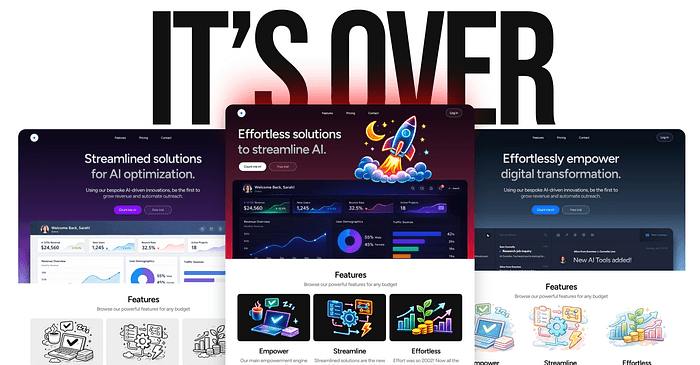
Vibe Coding is OVER, and the visual noise of 2026 is proving it. If you've looked at your feed lately, you've seen the convergence. Landing pages designed yesterday and landing pages designed next week look identical. They are generic commodities—akin to the famous IKEA LACK coffee table.
In bringing creativity to the masses, we didn't unleash innovation; we unleashed slop. The barrier to entry has dropped so low that execution has become indistinguishable from competence. We are drowning in options, yet consumers remain desensitized. Most SaaS is performative, peppered with buzzwords and flat design, obstructing the actual message.
This isn't about good design vs. bad design. It's about thinking vs. vibing. With AI widens the gap between those who can structure a solution and those who can only ask for one.
🧠 Core Explanation: The Death of Excitement
We are in a unique moment where AI optimization eats its own tail. Ten years ago, if you could auto-layout a rectangle in Figma, it looked like magic. Today, tools like Auto-layout and generative AI mediums have leveled the playing field so completely that "good enough" is the new acceptable standard.
The Result:
- Convergence: All sites look the same (gradient text, glassmorphism, stock photos).
- Desensitization: The mythical "end consumer" is overwhelmed. There are currently 192 of any specific tool. By the time you read this, there will be 193.
- Value Compression: The value of building has decreased. When everyone can build without effort, the price of that work approaches zero.
We are leaving the era of "Innovators" and entering the era of generators. Those who rely on convenience (vibe coding) are finding that speed doesn't buy loyalty.
🔥 Contrarian Insight
"Vibe Coding isn't killing design; laziness is."
The most dangerous misconception in 2026 is blaming AI for the quality drop. I started designing in the late 90s, and "slop" existed way before ChatGPT. It existed during flat design systems and Component libraries.
AI didn't create unskilled builders; it simply gave them scale. When you remove the friction of learning code or vectors because you can "just ask," you also remove the friction that forces you to think. You can generate faster, but can you visualize the why? True innovation requires a bias toward action and a bias toward reflection. If you don't care why a button is there, the AI won't care either.
🔍 Deep Dive: The Anatomy of SaaS Slop
The "Slop" isn't always ugly; it's calculated to be minimally offensive. It's a tributary of the "Average of Averages".
When AI models ingest millions of web pages, they stop learning "outliers" (great design) and start learning the "median" (safe, standard layout). This creates a homogenized output:
- The Hero Section: Gradient text promising to "Revolutionize Your Workflow."
- The Features: Three cards with interchangeable icons (Lucide, Heroicons).
- The Testimonials: Headshots that look like stock photos.
- The Icons: Geometric abstract shapes with purple-blue gradients.
The Economic Impact: If your product is indistinguishable from the 98% average, you rely on price or luck to win. Average products have a short lifespan. The market is shifting back to Minimum Viable Precision. Buyers are waking up to the fact that speed without quality is just an expensive prototype.
🏗️ The Solution: From Vibe to Craft
You are not going to "vibe" your way out of this era. If you want a product that survives, you need to do the things AI cannot do for you.
1. Reclaim the Thinking Process
Before you touch a single AI tool, you must define the problem. Write down:
- What specific pain point does this solve?
- Why is this different from what competitors do?
- What is the user journey?
If you tell an AI to "give me an app to do X," you get Idea Slop. You must articulate the why.
2. Develop "Taste" Through Observation
Stop optimizing your stack (Tool Obsession) and start optimizing your perception (Taste).
- Analyze: Look at great apps. Ask why a color is where it is.
- Connect: Apple didn't just rip off Braun; they understood how to create hierarchy.
- Fundamentals: If you can't draw a rectangle straight on a whiteboard, learn typography, spacing, and color theory. They never change.
3. Be "Barry Allen," Not "The Flash without Brakes"
Forget the FOMO. Don't hoard prompts. Prompts are just instructions; if you can't explain what you want, read the CSV file on Gumroad won't fix you.
- Slow Down: AI gives you saved time. Use it to polish, not to build more. Find the "delights" in your product.
- Own Decisions: Use AI to execute; use your brain to direct.
4. Define "Minimum Viable Precision"
Do not confuse shipping with iterating. An MVP should be a working solution, but it should still reflect your specific brand and user intent. If the first draft is "good enough," you are prioritizing your ego (speed) over the user.
⚔️ Tool Obsession vs. Skill
| Feature | Tool Obsession (Vibe Coding) | Skill-Based Mastery |
|---|---|---|
| Focus | Latest AI Model, Newest Framework | Fundamental Design & Product Sense |
| Input | Prompts & "Steal this prompt" packs | Deep problem understanding |
| Output | Generic, Average Quality | Unique, Polished, Usable |
| Mindset | "How fast can I build?" | "How well does this solve the problem?" |
The Golden Rule: The tool is a multiplier. If your base skill is 0, the AI multiplies 0 by 10x, and the result is still 0. If your skill is 10, the AI multiplies it, and the result is superior.
🔗 Related Topics
- Why the "No-Code" Movement is Stagnating
- The Death of the SaaS MVP: Why Shit Gets Boring
- System Design for AI: Moving Beyond Prompts
- Grafik Design Rules That AI Still Breaks
🔮 Future Scope
As we move further into 2026, the "Vibe Coding" era will inevitably fade. We will see a bifurcation in the market:
- Mass Commodities: Fast, cheap, average SaaS—built by automata.
- Premium Craft: Highly specialized, beautifully designed, deeply thoughtful products built by humans using AI as a tool, not a brain.
The window where "fast and cheap" sells will close entirely. The builders who survive will be the ones who spent that extra saved time learning the boring stuff—reading books on typography, sketching wireframes, and questioning every UX decision.
❓ FAQ
Q: Is "Vibe Coding" actually dying? A: The behavior of building without thought is not dying, but the term is becoming a self-fulfilling prophecy for failures. Software that relies on "vibes" rather than rigorous logic cannot scale.
Q: Will I lose my job because AI can design? A: AI lowers the barrier for mediocre work. If you are a mediocre designer relying solely on tools to guess, yes. If you are a creative operator using AI to augment your specific vision, your value will increase.
Q: Why do all AI logos look weird? A: Because AI models are trained on the average of human internet data, which is heavily distorted by automated generation over the last decade.
Q: What is "Minimum Viable Precision"? A: It’s an expansion of MVP. The rule is: Your product must be viable (functional) and precise (high quality, thoughtful design) from the first pixel.
Q: Should I stop using AI tools? A: No. Stop using AI tools to think. Continue using them to execute the plan you have carefully constructed.
🎯 Conclusion
"Vibe Coding is OVER." We have out-vibed sanity. It is no longer impressive that you can generate a website in minutes. The markets have clearly signaled a shift back to quality.
In 2026, speed is the new base price. You can move fast because everyone can. To win, you must move accurately. You must care about the details AI ignores. You must return to fundamentals, think deeply about who you are building for, and refuse to ship lazy code.
When the slop tsunami recedes, the clear water will not belong to the fastest swimmers, but to those who know how to swim. Don't just vibrate through the walls—choose the right wall to break through.
Share This Bit