AIGen AIAI Agents
Wingman: India’s Emergent Dawn of the Autonomous Agent Era
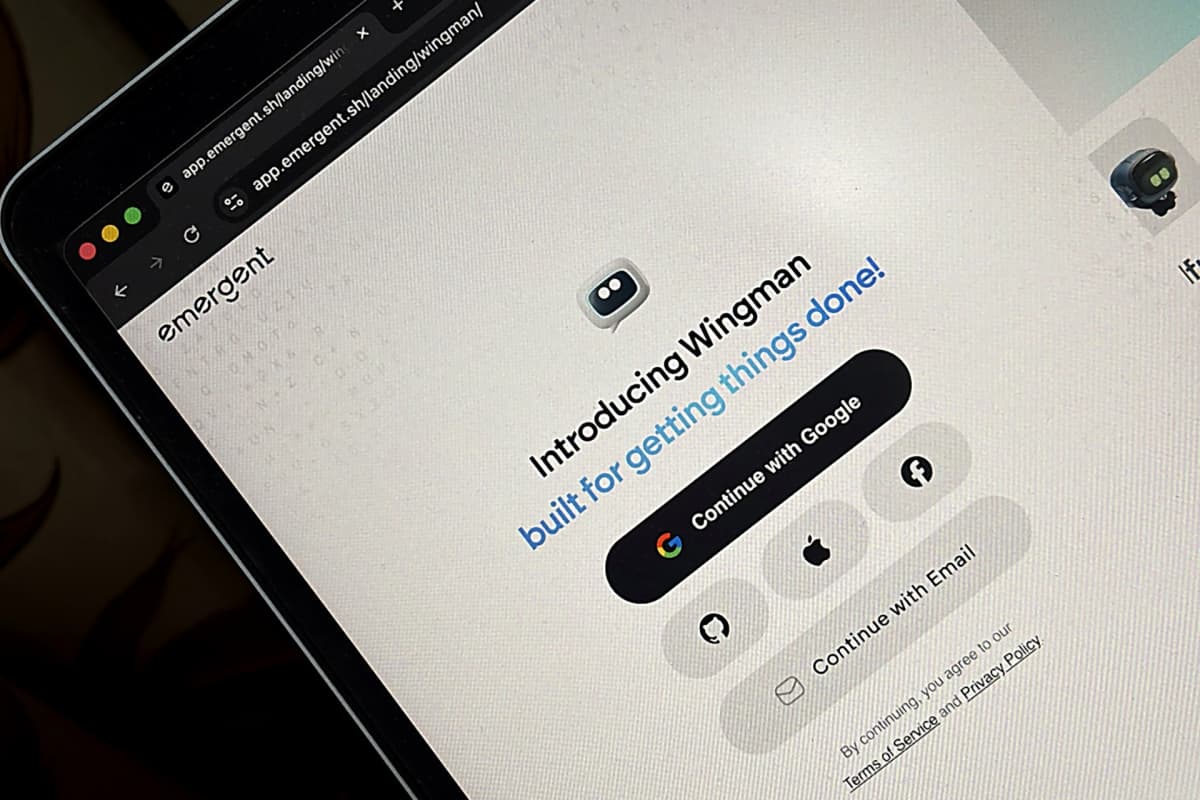
🚀 The Dawn of the Autonomous Agent: Emergent’s Wingman Shifts AI from Definition to Execution
The current paradigm of Generative AI is rendering the software development landscape unrecognizable. We moved from "vibe coding"—the elegant art of having an AI generate a full-stack app from a rough prompt—to "vibe running"—the sophisticated challenge of keeping that app alive and productive. The reactors are cooling, but the fires are getting hotter. Now, a new frontier has emerged, one where the creation is just a prelude to the action. Enter Wingman, an ambitious leap from Bengaluru-based startup Emergent that signals the end of the era where AI merely writes code, and the beginning of an era where code is the servant of autonomous intelligence.
If you consider the trajectory of the smartphone, you might notice a cyclical nature: Symbian was the shell, iOS and Android were the operating systems, and built-in apps were the native tools. Now, we are witnessing the shift toward "Software 2.0," where the operating system is the LLM, and the apps are the agents. Wingman is not just another chatbot; it is a fully autonomous "sidekick" capable of navigating the complex, siloed web of corporate algorithms on your behalf. By integrating directly into WhatsApp, Telegram, and iMessage, Emergent is attempting to bypass the clunky necessity of native apps entirely, serving as the Rosetta Stone between human intent and digital execution.
In this deep dive, we will analyze why this move is a watershed moment for AI infrastructure, how the "Trust Boundary" architecture solves the safety crisis in autonomous systems, and what this means for the engineers of 2026.
TL;DR: Emergent's new "Wingman" AI agent moves beyond the capability of simple code generation into full autonomous execution. By embedding itself in messaging apps and implementing strict "Trust Boundaries," it addresses the critical safety gap in the autonomous agent marketplace, marking a fundamental shift in how humans interact with software workflows.
💡 The "Why Now" Shift
Why is the launch of a single agent product such a seismic event in the tech ecosystem? Because the industry has finally solved—or at least acknowledged—the "pre-AGI" bottleneck. For the last two years, investments flowed into foundation models because text generation was the low-hanging fruit. Now, the money is following the utility. The explosive growth of "vibe coding" platforms has proved that non-technical users possess a desire—and the aptitude to define—complex functionality.
The math is undeniable. Emergent claims 8 million builders have utilized their platforms, with 1.5 million monthly active users. A valuation of $300 million, secured just weeks ago with a $70 million Series A (backed by SoftBank and Lightspeed), validates that this is not vaporware. The market is saturated with "vibe coding" clones, but that growth has hit a ceiling. You can't vibe code a marketing calendar without actually doing the marketing. The natural next step for the data in the platform (who is building what, when, and for whom) is to utilize that data to execute tasks.
Currently, the dominant players in the autonomous agent space, such as OpenClaw, have forced the conversation toward privacy and operational safety. However, they are largely isolated within developer environments or closed developer communities. Emergent’s global distribution strategy leverages WhatsApp—with its 2 billion users—and Telegram to introduce agents to the masses. This is the "Android moment" for AI agents: moving from niche developer tools to ubiquity.
This shift addresses a critical dissatisfaction in the modern enterprise: Context Switching Sickness. Employees spend more time jumping between Zoom calls, Gmail, Jira, and Slack than doing actual focus work. AI agents like Wingman remove the middleman, allowing a user to conceptualize a workflow in natural language and have it materialize in their existing tool-stack without a single mouse click.
🏗️ Deep Technical Dive: Architecture of the "Trust Boundary"
To understand the significance of Wingman, we must deconstruct its architecture. It is not a simple rubber-stamp layer over an LLM. It is a sophisticated orchestration engine that introduces the concept of the "Trust Boundary."
🛡️ The Trust Boundary Protocol
The central innovation of Wingman is its tiered permission system. In the realm of autonomous agents, safety is the inverse of speed. If an agent is too free, it becomes dangerous; if it's too restricted, it's useless. Emergent posits a hybrid model where routine tasks exist in the "Trust-Free Zone" and consequential actions exist in the "Approval Zone."
From an architectural standpoint, this is implemented through a reinforcement learning loop. The agent executes a low-complexity action (e.g., creating a calendar entry for a coffee meeting) and does not perform a cost-heavy reasoning check because the cost of failure is low. Conversely, when tasked with modifying a critical database schema or sending bulk email campaigns, the system triggers a Human-in-the-Loop (HITL) protocol.
# Pseudo-code representation of the Trust Boundary Logic

class WingmanAgent:
    def execute_task(self, intent, tools_available):
        intent_complexity = self.analyze_intent_complexity(intent)

        if intent_complexity == "LOW":
            # Autonomous execution with negligible risk
            auto_approval_required = False
        elif "DELETE" in intent or "FINANCE" in intent:
            # High consequence action requires permission
            auto_approval_required = True
            user_notification = self.create_notification(intent)
            self.send_to_message_queue(user_notification)
            return "WAITING_FOR_USER_CONFIRMATION"

        return self.run_with_tools(intent, tools_available)

    def analyze_intent_complexity(self, intent_text):
        """
        Uses a smaller, faster classifier (DistilBERT or similar)
        to score intent before the heavy LLM wakes up.
        """
        score = self.cheap_classifier.predict(intent_text)
        return "HIGH" if score > 0.75 else "LOW"
The code above illustrates the "pre-check." The agent traverses the ReAct (Reasoning + Acting) loop. First, it thinks (Reasoning) about what it needs to do. If the intent analysis deems it safe based on the keywords and context, it acts (Action) instantly. If the system detects ambiguity, "Trust X" is activated, halting execution until the user provides a clearer signal. This dual-mode architecture is likely where Emergent’s competition (like Anthropic or OpenAI’s internal agents) is currently struggling to find equilibrium.
🧠 Cognitive Load Management via Mode Switching
Emergent’s CEO, Mukund Jha, noted that "real work already happens through chat and voice." This insight drives the architecture's design around "Mode Switching." The agent does not dominate the inbox; it waits in the background ( asynchronous computing) until called upon, then springs into action.
This is distinct from traditional chatbots. A traditional bot is stateless; every message requires the bot to re-read the whole history of the conversation. A true agent like Wingman must maintain long-term contextual memory. By integrating with WhatsApp and Telegram APIs, the system uses the platform's notification system to surface tasks. This effectively turns the standard push notification into a "Job Ticket" that the agent is delivering to the user's awareness stack.
🎯 The "Vibe Coding" DNA
While Wingman is for execution, its lineage is rooted in Vibe Coding. Emergent’s initial platform allows non-technical users to build apps via prompts. This implies the training data for Wingman includes millions of user-generated prompts and API calls. The startup essentially possesses a dataset—"Emergent-600B" (hypothetical)—containing the specific syntax, abbreviations, and ergonomic choices that non-developers make when interacting with code.
When Wingman executes a task, it isn't just tapping an API; it's mimicking the "style" of the user. It understands the idiosyncrasies of how the business operates. If a user asks for "some font tweaks" in a previously built vibe app, Wingman knows which font the user prefers and where.
📊 Real-World Applications & Case Studies
The theoretical potential of autonomous agents is high, but the practical application is what cements a startup's future. How is Emergent’s user base applying Wingman in production environments?
📅 The "Butler" for Corporate SaaS
Consider a scenario involving a mid-sized marketing agency using Emergent’s platform to build custom project management tools.
- The Setup: The agency’s team builds a CRM dashboard inside the Vibe-Coding environment.
- The Entry: A client asks a team member, "Hey, what are we doing next week?"
- The Agent Action: The team member turns to Wingman. Instead of opening Jira, Slack, or a calendar manually, they simply type to their personal WhatsApp business account: "Ask Wingman to summarize our team's workload for next Tuesday regarding Project Alpha."
- The Execution: Wingman authenticates (OAuth handshake), scrapes the project metadata, synthesizes the data, and returns a concise summary.
- The Verification: Because this involves external project data, Wingman triggers a Trust Boundary. It summarizes and sends it, but flags it with a "Send to Email" button. The team member clicks once, and the decision is executed.
🔧 Autonomously Updating "Shadow IT"
Organizations today are plagued by "Shadow IT"—software built by employees that IT doesn't support or understand. If the engine driving Shadow IT is Vibe Coding, then the management of Shadow IT should ideally be pure AI automation.
Use Case: An internal sales tool was built by a rep using a template three months ago. It has a bug where customer names are capitalized incorrectly in the automated email drafts.
- Human Effort: This would have required a developer to be paged, to reproduce the bug, and then redeploy.
- Agent Effort: A sales rep notices the glitch and tells Wingman: "Fix the email generation logic so names are capitalized correctly based on the database regex."
- Result: Wingman navigates the app source code, identifies the failing function, applies a regex fix, and redeploys the microservice. All without a commit message from a human developer.
🔎 Research Aggregation
For knowledge workers, time on email is treasure. Wingman excels at "Fact Eating." It can traverse a list of 50 unread emails, filter the noise, extract the action items, generate a list of "To-Dos," and append them to the user's iMessage inbox.
Unlike standard email prompting (e.g., "Summarize my last 50 emails"), Wingman can proactively initiate the next step. "Sarah wants a meeting," concluded Wingman. "I have blocked a slot. Approve?"
⚡ Performance, Trade-offs & Best Practices
While the vision is impressive, the system is not magic. To leverage Wingman, engineers and architects must understand the performance trade-offs and the "Black Mirror" nature of fully autonomous systems.
🧱 The Latency Tax
Running an LLM with a tool-use chain has a latency cost. If you ask Wingman to "book a flight to New York next Tuesday," the journey involves:
- Inference: Understanding the intent.
- Context Retrieval: Looking at user preferences (lounges, times).
- Tool Invocation: Calling the Expedia (or similar) API.
- Screen Scraping (Potential): If the flight search UI is not API-first, the agent might need to "see" the page.
This can result in a delay of 3-5 seconds. In a text chat, this is imperceptible. In a live phone conversation, it is jarring. The performance sweet spot for Emergent lies in non-time-sensitive "office tasks" rather than high-frequency trading or gaming logic.
💸 The Token Economy
Every time an agent uses a tool, it consumes tokens for the context window.
- Input Tokens: The user's prompt.
- Output Tokens: The API response from the tool (e.g., a JSON payload of gigabytes from a database dump).
- System Prompt Tokens: Instructions explaining how to act.
If a user asks Wingman to "organize the entire company file system," the agent will likely receive gigabytes of file metadata. If the agent outputs a summary of that data, the cost is staggering. Wingman mitigates this through aggressive Summarization, truncating API responses, and using "Supplier" models for retrieval rather than reasoning-heavy models.
⚠️ Ambiguity and "Messy Edges"
CEO Mukund Jha admitted the system struggles with "messy edge cases." This is the single highest-risk area for CTOs. If an agent has permission to execute tasks but not permission to understand them fully, the semantic gap widens.
Best Practice for Enterprises:
- The "Glass Box" Approach: Never give an agent permission to destroy or permanently delete data. Limit the scope of its "Trust Boundaries" to Read-Only modification or Append-Only manipulation (e.g., adding a row to a database or a ticket to a board), rather than overwriting existing columns.
💡 Expert Tip from BitAI Architecture: When deploying agent-based systems, implement a "Sand-Glass" Sandbox. Before the agent orients itself in a workspace, it should dump the state to a read-only view. It calculates the plan in the Sandbox, proves the plan works on the data, and then asks permission to mutate the live environment. This prevents "Black Swan" errors where an agent deletes a production asset while trying to reformat it.
⚖️ Human Judgment Preservation
Autonomous agents excel at predictive decision making (e.g., "If you usually sleep at 11 PM and the meeting ends at 10 PM, schedule it"). However, they fail at judgment (e.g., "Cancel this meeting; it's with a sponsor I have a bad relationship with").
The best architectures force agents to flag Subjective decisions. If a user asks, "Can you attend this kickoff meeting?" the agent should answer, "I can add it to your calendar, but are you sure you want to attend? The mood is described as 'intense' in the invite." This forces the human to remain the ultimate arbiter of business logic.
🔑 Key Takeaways
- 🤖 Directional Shift: The industry has successfully pivoted from Generative (creating code) to Agentic (executing workflows), with players like Emergent leading the charge in mobile-native execution.
- 🔒 Safety via Architecture: The "Trust Boundary" protocol proves that autonomy and safety are not mutually exclusive; they are inverse variables managed by permission-tiered logic.
- 🏆 Platform Ubiquity: By leveraging WhatsApp and Telegram rather than building proprietary apps, Emergent cuts through the fragmentation of the "App Economy" to become the invisible layer over existing tools.
- 📊 Scale Matters: Emergent’s data moat—which includes 8 million builders and 1.5 million active users—is the primary competitive advantage that interprets natural language commands into proprietary software logic.
- 🧠 The Perception Gap: While agents mimic human agency, they act on probability, not intent. Misunderstanding was highlighted as the primary failure mode in non-routine scenarios.
- 💰 Valuation Confidence: The $300 million valuation backed by SoftBank and Lightspeed highlights that when an AI company solves a 'doer' problem rather than just a 'thinker' problem, the risk-adjusted returns are significant.
- 🔄 Shadow IT Management: Agents represent the only logical solution to the rising complexity of corporate software stacks, capable of autonomously maintaining the very tools built by their creators.
🚀 Future Outlook
Looking ahead to the next 12 to 24 months, the trajectory of Wingman and the broader "AI Agent" market suggests a future where "Software Breeds Software that Runs It."
We are moving toward a Closed-Loop Ecosystem. Currently, agents struggle to move data between competitive silos (e.g., Salesforce vs. HubSpot vs. Google Workspace). In the future, we will see the standardization of "Agent APIs"—unified endpoints that allow any AI agent to query or modify data without engaging in manual UI scraping. Emergent is implicitly paving the way for this with its focus on interoperability.
Furthermore, expect Wingman to evolve from a "Command Center" into a Cognitive Agent. It will eventually be able to proactively recognize patterns. It won't just "summarize tasks"; it will recognize that you always skip meetings on Fridays and notify you before scheduling one. It will curate your news feed based on your actual decisions, not just botched clicks.
The $70 million raise from SoftBank indicates a battle for dominance in the "Android of Agents." If Emergent can maintain its growth trajectory, it could become the OS that thousands of niche AI agents run on top of. The "Vibe Coding" era was the discovery of the language; the "Wingman" era is the societal integration of that language into our daily operational reality.
❓ FAQ
💬 What is "Wingman" exactly?
Wingman is an autonomous AI agent developed by the Indian startup Emergent. Unlike traditional chatbots that merely respond to prompts, Wingman is designed to execute tasks autonomously by interacting with connected software tools (like calendars or emails) across workflows. It serves as a "messaging-first" assistant that can proactively or reactively manage your digital environment through chat platforms like WhatsApp and Telegram.
🛠️ How does the "Trust Boundary" work?
The Trust Boundary is a safety mechanism designed to allow AI agents to operate autonomously without posing a security risk. It creates a tiered permission system: Routine or low-risk actions (like sending a calendar invite) can be executed instantly without approval. However, high-risk actions (like sending a broadcast mass email or modifying critical databases) trigger a user confirmation request. This balance prevents the agent from making costly, irreversible mistakes.
🆚 Is Wingman similar to other AI agents like OpenClaw?
Yes and no. All current autonomous agents share the goal of reducing human effort in software workflows. However, OpenClaw is primarily known as a developer-focused tool or a "bot" infrastructure for specific developer tasks. Wingman differentiates itself by being deeply embedded in communication platforms (WhatsApp, iMessage, Telegram) and tailored toward a broader, non-technical user base (1.5 million active users), focusing on the "vibe-coding" ecosystem's next logical step: automation.
🏗️ What is "Vibe Coding" and how does it relate to this news?
Vibe coding is the practice of using Generative AI to build full-stack software through natural language prompts, allowing users with no traditional programming background to create software. Emergent is the originator of this concept. The launch of Wingman is the direct evolution of this platform; once you use Vibe Coding to build software, Wingman is the agent that operates and maintains that software for you.
🤖 Will Wingman eventually replace human workers?
Wingman is designed to handle routine and operational tasks, acting as a force multiplier for human productivity rather than a threat to employment. Its current code suggests it struggles with "ambiguous situations" and tasks requiring high-level human judgment. In an enterprise context, it is likely to redefine roles—shifting human effort from repetitive execution to creative strategy and oversight—rather than simply eliminating the human entirely.
🎬 Conclusion
The synergy between code generation and autonomous execution creates the single most disruptive force in technology since the release of the iPhone. Emergent has successfully bridged the gap between the imagination of the creator and the reality of the operator. By wrapping these capabilities into the ubiquitous medium of messaging apps, they have effectively patched the user interface gap that has hindered AI adoption for years.
As we move toward a future where our digital tools act as extensions of our will rather than windows we must click through, Wingman stands as a pivotal example. For engineers and architects alike, this proves that the "how" is just as important as the "what." Build the right architecture, and you don't just write code—you build a workforce.
Continue exploring the architecture of the next internet on BitAI.
Share This Bit